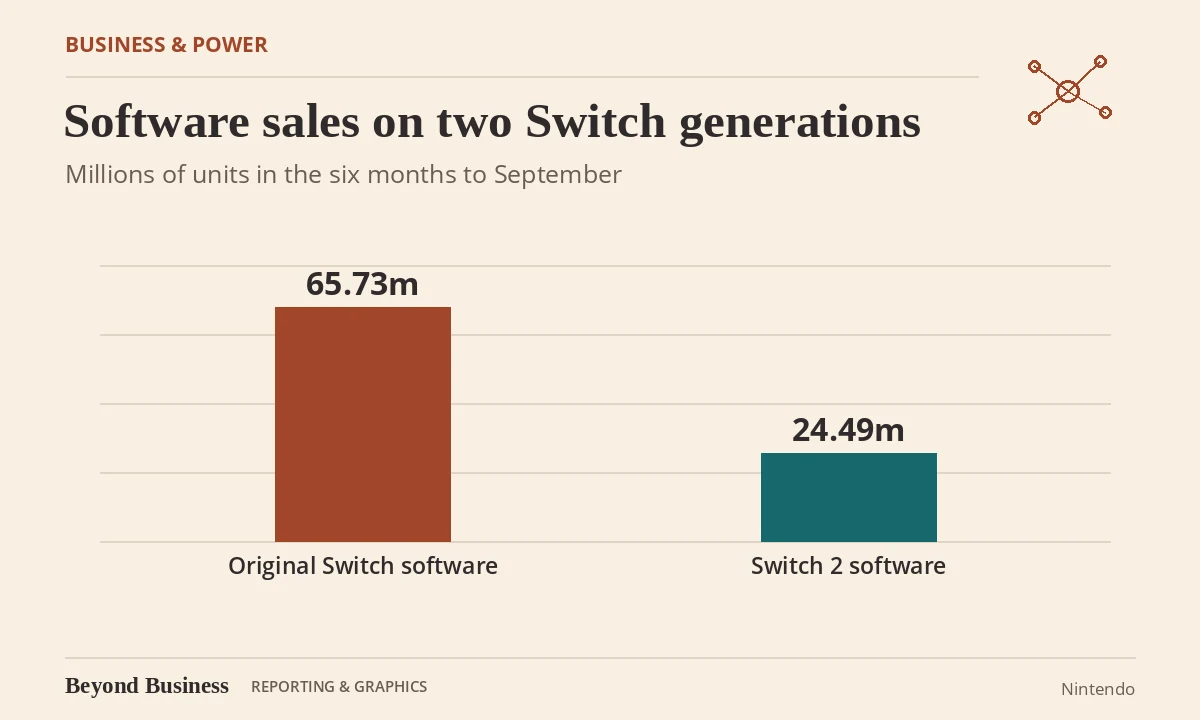
- Original Switch software sales rose 6.8% in six months to September.
- Switch 2 software reached 24.49 million units.
- The figures cover units and include specified bundles.
Inside this story 2 perspectives
Nintendo has a customer who rarely makes the news. This person can walk past the hardware aisle, go home with a game and use a machine they bought years ago. In the six months to September, software for the original Nintendo Switch sold 65.73 million units. That was an increase of 6.8% on a year earlier, by which time the successor console was already on sale.
The company's 5 November figures give that customer a place alongside the people still buying new machines. Original Switch hardware sold 1.27 million units in the period, down almost a third. Software for that same family went up. An older machine in a living room can continue to be a route to market for everyone who makes a game for it.
Two generations at the till
Nintendo sold 6.49 million Switch 2 machines in the half year, down 37.4% on the launch-period comparison. It sold 24.49 million units of Switch 2 software, up 18.8%. For a retailer contemplating the December holidays, those four numbers describe quite different shelves. Someone buying a machine for the first time may need help choosing the right version. Someone buying a gift for a household that already has one needs to know which machine is plugged in at home.
A simple division of games by machines sold during the period would give a misleading picture of any individual player. The software customer could have bought a console in a previous year. Games may also come with hardware. Nintendo identified about 1.05 million Switch 2 software units and 400,000 original Switch software units sold in bundles during these six months. A game in a box and a separate decision at the till are different things for a publisher trying to understand demand.
The value of a shelf that stays open
Consider the position of a studio deciding where its next game belongs. There is prestige and attention attached to the newer machine. There are also millions of people who know the older one, have space for it by the television and may be willing to buy another game without spending on hardware. The decision depends on the needs of the game as much as on the age of the console. A period of rising software sales on an older platform makes that calculation worth doing.
Nothing in the figures identifies who bought a second copy for a family member or which household eventually traded up. They do establish that a decline in new-machine sales left room for growth in what people did with machines already sold. Long after a console has disappeared from the family shopping list, its owner's next birthday can still matter to the games business.