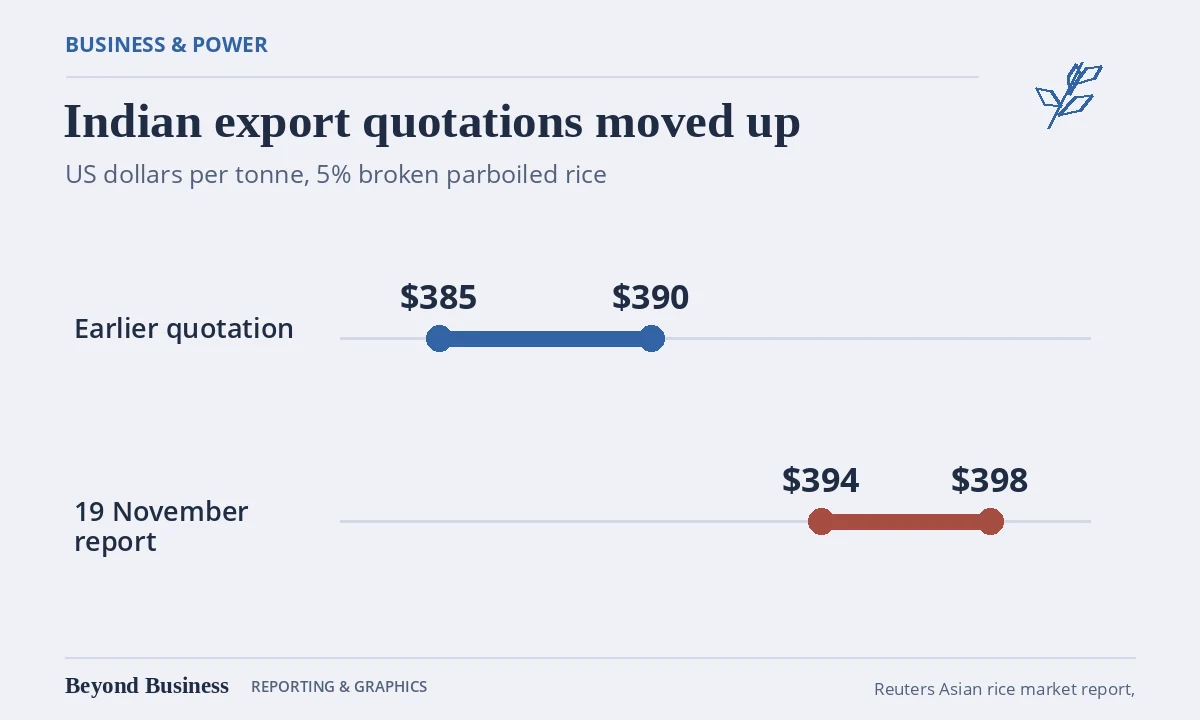
- The quoted price for Indian 5% broken parboiled rice rose week on week.
- Freight, currency conversion and older inventory affect how a quotation reaches a retail shelf.
- USDA lowered its import forecasts for Senegal and Côte d’Ivoire as local rice competed for buyers.
Inside this story 2 perspectives
A wholesaler replacing a shipment of Indian rice this week faced a more expensive offer than the week before. Traders quoted India’s 5% broken parboiled rice at $394 to $398 a tonne, up from $385 to $390, Reuters reported on 19 November. For an importer paying in dollars, the change is visible immediately on a fresh quotation. For someone buying a bag in Dakar or Abidjan, the timing and size of any change are far less straightforward.
Traders pointed to a firmer Indian rupee, higher paddy prices and buying interest from Africa. A stronger rupee can push an exporter to ask for more dollars to cover costs paid in local currency. The figures refer to one grade of rice, quoted in a particular week. A tonne of a different variety, or an order contracted a month earlier, can come with a different bill.
What the buyer actually pays
Consider the journey of one consignment. The buyer starts with a supplier’s offer, then accounts for transport, insurance, handling and the cost of moving stock inland. Exchange rates matter again when the importer converts the bill into the currency of local customers. An increase at the exporting end therefore arrives alongside other costs that can change in either direction.
Existing inventory complicates the picture further. Two wholesalers trading in the same city might have bought their stock at different times. One needs to replenish immediately, while the other still has rice purchased under an earlier contract. Even if both see the same Indian quote, they need not adjust their selling prices together. A weekly market report cannot settle an argument about what a particular shop should charge.
A local mill changes the equation
The US Department of Agriculture’s November rice outlook offers a second perspective. It cut its forecast for Senegal’s 2026/27 rice imports by 200,000 tonnes to 1.2 million, citing the competitiveness of locally grown rice and higher prices for imported broken rice. It lowered the corresponding projection for Côte d’Ivoire by 100,000 tonnes to 1.6 million, pointing in part to greater availability of domestic rice. These are revised forecasts, not counts of cargoes already unloaded.
India can carry substantial stocks even as current offers rise. A separate Reuters investigation this week traced that stockpile to years of state-backed buying. Rice in government storage and a particular grade available to ship this week are different measures of supply.
The country figures also cover a broader set of rice varieties than the Indian parboiled quotation. What links them is the choice facing the buyer. A retailer can compare when a local mill can deliver, how consistently the grain cooks, which pack sizes customers buy and how much cash a large import order ties up. The answer may differ between two neighbourhoods, let alone two countries.
For families budgeting for food, the Indian quote is one early sign to watch. The more revealing comparison is closer to home, between equivalent bags on the shelf and the price of the next shipment or local delivery that will replace them.
Watch the film · The Price of Rice