- Two unusual fossils from Wyoming’s Sundance Formation were assigned to a new genus and species.
- The preserved guard reached about six centimetres in diameter at its broad end.
- The fossils record a squid-like cephalopod that lived in an inland sea about 160 million years ago.
Inside this story 2 perspectives
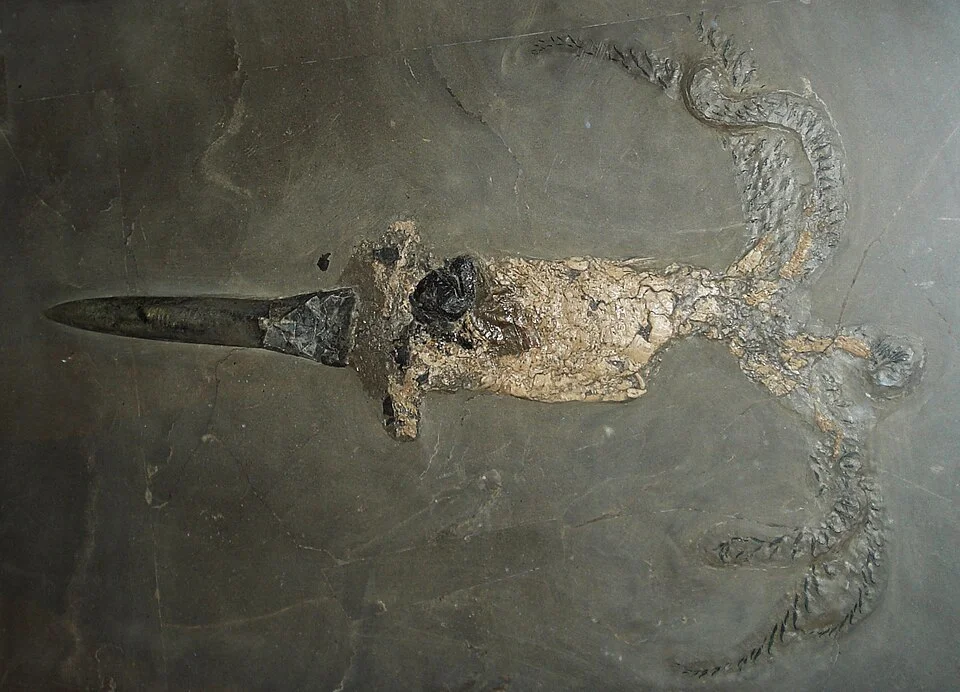
To see what was so unusual about a newly named Jurassic animal from Wyoming, it helps to put a ruler across the fossil rather than along it. Its hard internal support was only about ten centimetres long. Across its broad end, however, it measured as much as six centimetres. Ordinary finds of this kind from the same region are commonly only one or two centimetres across.
Two such specimens have now been described as a new genus and species, Wyoteuthis linsterorum. The research appeared in Papers in Palaeontology on 9 September and was reported by Discover Wildlife on the 12th. The species was a belemnite, a relative of modern squid and octopuses, living about 160 million years ago in a sea that covered part of what is now the western United States.
What a guard can preserve
A belemnite’s hard internal structure, often called a rostrum or guard, has a much better chance of surviving than the soft parts of the animal. Its familiar shape in many species resembles a pointed bullet. Finding a guard tells a palaeontologist about the proportions of that piece of the skeleton. It usually leaves a quite different problem for anyone trying to illustrate the whole swimming animal.
The Wyoming material is broad enough to change the usual proportions from the outset. The research describes the two guards as the thickest so far known among belemnites. That is a specific claim a reader can understand from the specimens. An estimate that the living animal could have measured around sixty centimetres, including its arms, depends on reconstructing the parts that are missing. The researchers did not recover a complete animal sixty centimetres long.
Why two pieces deserve attention
Wyoming’s Sundance Formation is hardly short of belemnite fossils. Familiarity can be useful in such a collection, because an unusual shape stands out against a well-known range. The research team compared both unusual finds with material from other belemnites to decide whether the shape belonged within an established group or warranted a new name. Scientific naming follows that work of comparison.
The inland sea that deposited these rocks also makes an instructive demand on the imagination. Today a fossil can be found far from an ocean beach. The relevant landscape for the living animal was the ancient marine basin, not the present-day map of a landlocked state. The rock formation supplies the setting that a small piece of skeleton cannot convey by itself.
A drawing can put flesh, arms and movement around these finds. The most persuasive particular remains something much quieter: two pieces of a frequently preserved structure, each broad enough to make an experienced observer look at a familiar fossil differently.