- DART shortened Dimorphos’s orbit around its companion Didymos by 33 minutes in 2022.
- Hera’s images reveal a crater extending across one face, while boulder fields elsewhere remain recognisable.
- Hundreds of orbiting boulders will matter as the team prepares closer observations and the release of two CubeSats.
Inside this story 2 perspectives
For four years astronomers knew what time a small asteroid would come round again, but could only speculate about the dent a spacecraft had left in its side. On Wednesday, the European Space Agency released close-up images that finally put a shape to that dent. A crater roughly the size of a sports stadium flattens one face of Dimorphos and extends across its width. On other parts of the same moonlet, boulders look much as they did before impact.
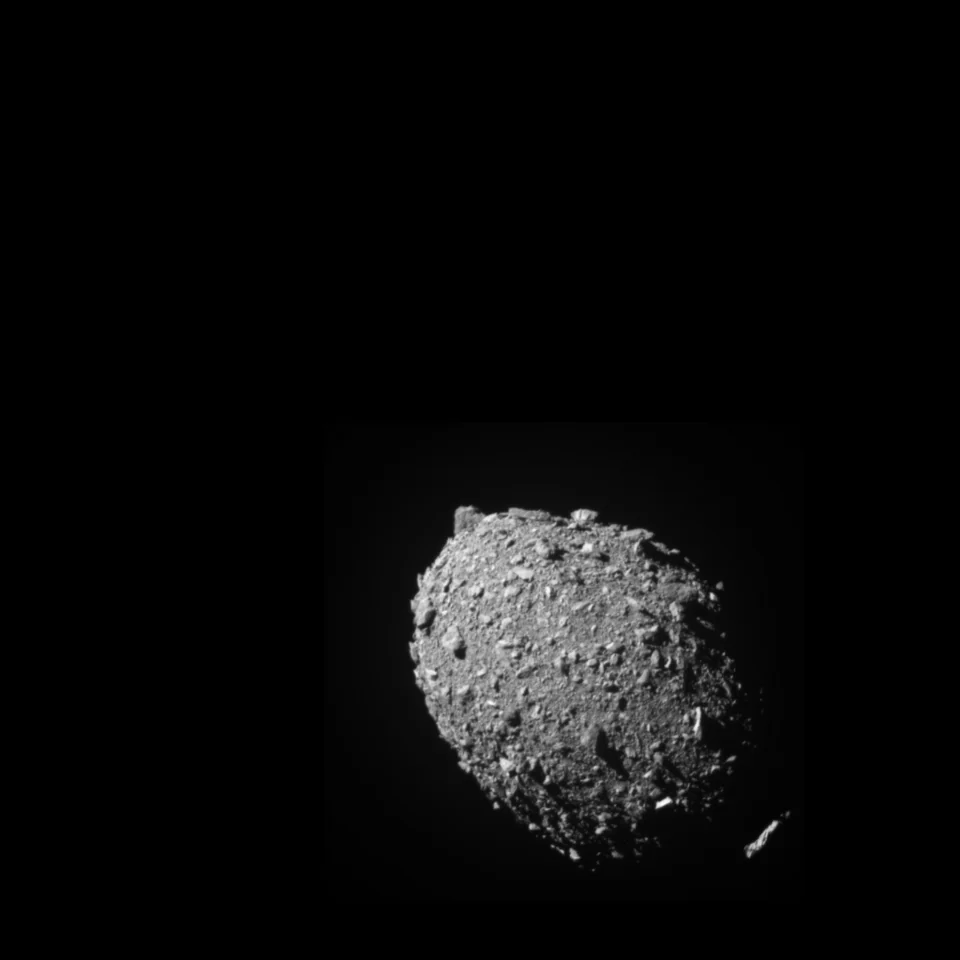
Dimorphos is the smaller member of a pair. At about 151 metres across, it travels around Didymos, which ESA measures at about 730 metres across. Neither posed a threat to Earth. On 26 September 2022, NASA’s DART spacecraft deliberately struck the smaller body. Telescopes on Earth established that Dimorphos took 33 minutes less to complete each circuit of its companion afterwards. That was the number researchers could measure from home.
The view from a second spacecraft
DART carried a camera. In its final photographs the moonlet grows from a speck to a rock-strewn landscape. But a camera that ends its working life at the instant of collision can supply only the first half of a before-and-after comparison. ESA sent Hera to take the second look. From tens of kilometres away, its framing camera could distinguish the flattened face of Dimorphos from terrain that still matches the older photographs.
A sequence also tells scientists something that a single frame cannot. As more pictures arrived, the mission team could see that Dimorphos was tumbling as it travelled around Didymos. Rotation and orbit describe two different movements. An orbit is the trip around the larger body, which astronomers had already timed. Tumbling describes how the smaller body turns during that trip, changing the face it presents to a camera.
The space between the rocks
Even the apparently empty surroundings turned out to contain landmarks. Hera has detected hundreds of boulders a few metres across travelling around the pair. In long exposures that suppress the bright light of the two asteroids, the small objects leave trails. The mission team now has to take them into account as it plans closer observations.
The crater establishes what one side of the moonlet looks like, but its outline alone cannot tell scientists how material is arranged below the surface. Hera is due to move closer in December. Two small spacecraft it carries, Milani and Juventas, are scheduled for release in January to help examine surface composition and the interior. For the first time the team can line up three different kinds of evidence from the same experiment. They have what DART saw on its way in, what telescopes timed afterwards and what remains there today.