- The quasar J1504+6252 has a redshift of 8.13, the first confirmed quasar beyond eight.
- Euclid identified the candidate. Ground-based telescopes, Hubble and Webb contributed to follow-up work.
- Its estimated mass and relatively slow feeding rate constrain possible accounts of earlier growth.
Inside this story 2 perspectives
Among millions of objects in observations from the European Space Agency’s Euclid telescope, one red point turned out to be the light from a galaxy’s core when the universe was about 630 million years old. Astronomers announced the discovery on Tuesday. The quasar, catalogued as J1504+6252 and nicknamed Dún Aonghasa, is the most distant yet identified. It takes the record about 40 million years further back in cosmic history.
A black hole weighing roughly 360 million times as much as the Sun powers that light. A black hole itself emits no light from within its boundary. The spectacle comes from matter falling towards it. Gas growing hot on the way in can make the centre of a galaxy bright enough to be seen across enormous distances. That brief, brilliant phase is what astronomers call a quasar.
A wide search and a narrow beam
The discovery took two different kinds of observing. Euclid can scan large stretches of sky in the infrared, giving astronomers a chance of picking out rare objects from very large catalogues. The team found the candidate in about 18 months of data. A tiny red dot in a survey image, however, cannot on its own establish either its distance or the mass of the object powering it.
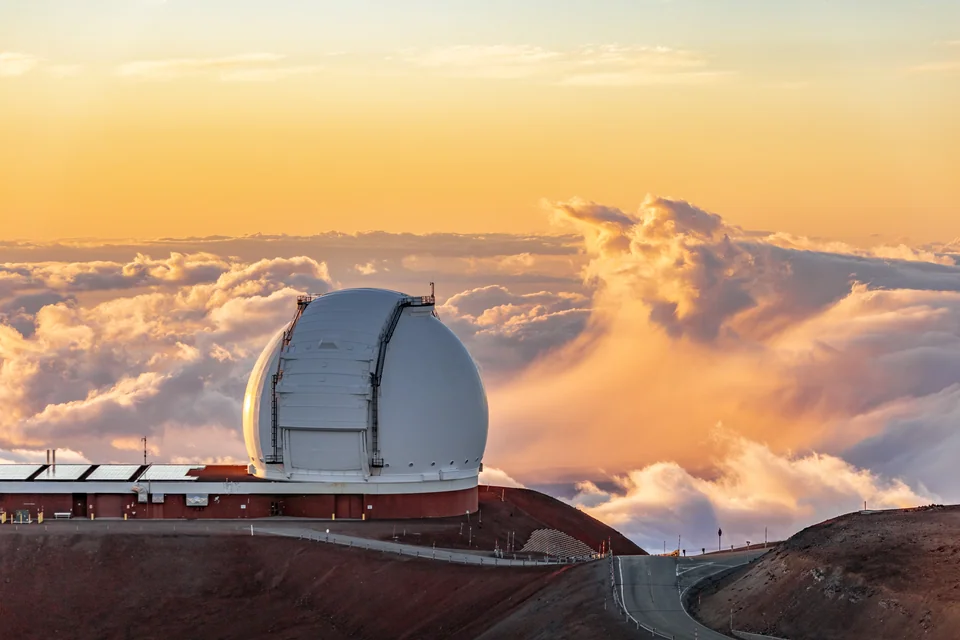
Follow-up work brought in the W. M. Keck Observatory, the Large Binocular Telescope, Hubble and the James Webb Space Telescope. Webb’s observations helped establish the mass of the central black hole. The confirmed redshift was 8.13, taking a known quasar beyond eight for the first time. Redshift reflects the stretching of light as the universe expands. A spectral feature that began at one wavelength arrives at a longer one, allowing researchers to identify it and measure the shift.
The record belongs to a quasar. Other kinds of distant objects belong to different searches. What makes this specimen especially interesting is the combination of a very early date, a substantial mass and a surprisingly modest rate at which the black hole appeared to be feeding when the light set out.
The missing part of the history
A single observation captures the engine in one phase. It does not supply a continuous record of how the black hole assembled its mass. Faster feeding at an earlier stage, or a sufficiently massive starting object, could help to account for its size. Distinguishing possibilities like those takes more than finding the earliest example and working backwards from it.
Euclid has identified a dozen previously unknown quasars beyond redshift seven, according to the research team. A sample gives astronomers something a record holder alone cannot provide. They can compare black holes of different masses seen at similarly early times and ask how often an object this large was present. The red point has earned its place in the record book. Its value for the next search lies in having other points to set beside it.