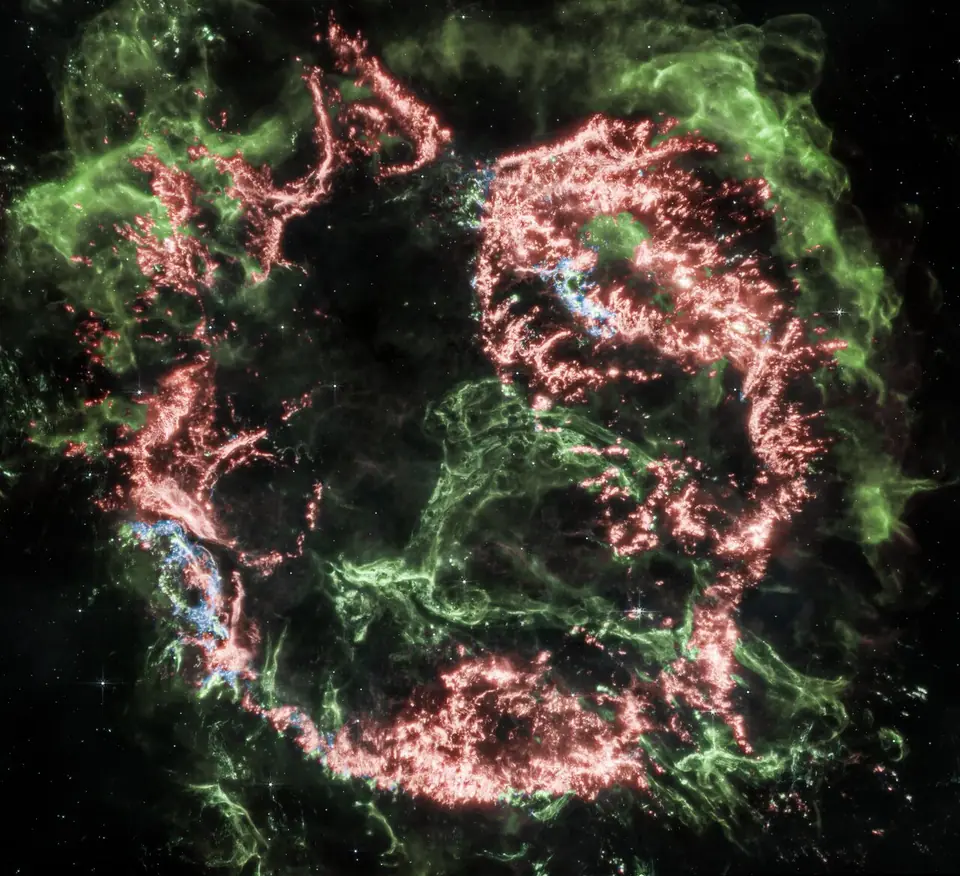
- Webb resolved individual clumps in two supernova-debris regions that Spitzer had identified for closer observation.
- One region was rich in silica dust and another in carbon, while the Green Monster contains material shed before the explosion.
- The timing of the proposed shell merger is inferred from the debris and supporting observations, centuries after the blast.
Inside this story 2 perspectives
One patch of wreckage is rich in silica. Another is mostly carbon dust. Both belong to Cassiopeia A, the remains of a massive star that exploded centuries ago. A team using the James Webb Space Telescope reports that the differences between these patches offer evidence about the star’s last hours. Two layers far below its surface appear to have mixed shortly before it blew apart.
Astronomers led by Tea Temim of Columbia University published their findings in The Astrophysical Journal Letters on Monday. No telescope watched those layers meet. The team worked backwards, starting with light from dust grains that formed in the debris. Webb could distinguish clumps roughly the size of our solar system. That made it possible to ask what a particular knot of material was made of before attempting to describe the entire remnant.
What Spitzer marked for a closer look
An earlier infrared telescope, Spitzer, had already flagged three interesting areas. Its observations gave the team places to look. Webb’s sharper mid-infrared view let researchers tease apart material that had appeared blended together. Two of the targets sit where a shock wave runs back into debris thrown out by the explosion. In one of these regions the team identified dust dominated by silica. In the other, carbon was the main ingredient.
The third target has a name left over from earlier Webb images, the Green Monster. It yielded another family of grains, rich in magnesium silicates. Its history is different too. This material came from the star before the explosion, when the star shed matter into its surroundings. A photograph can put all three areas in the same frame even though they record different episodes. Treating every bright knot as a sample of the blast itself would erase that distinction.
Reading the star from the outside in
Inside a massive star, successive stages of nuclear burning produce layers with different ingredients. If neighbouring layers churn into one another, the mixture of elements available when the star explodes changes. As some of that material cools and condenses, the resulting grains can retain clues to their origins. Webb’s dust map and earlier X-ray observations together support a merger late in the star’s life, possibly only hours before its core collapsed. That timing is an inference from the evidence.
The grains have a future as well as a past. A reverse shock can damage dust on its way out of a supernova remnant. The amount that survives matters because interstellar dust becomes raw material for later generations of stars and planets. Knowing which kinds formed, and where the shock encounters them, gives astronomers a sharper question to pursue than simply asking how much dust a dying star makes.