- Perseverance recorded the alignment on 2 July. NASA described it publicly on 5 August.
- Earth was about 314 million kilometres away and occupied roughly one pixel in the rover image.
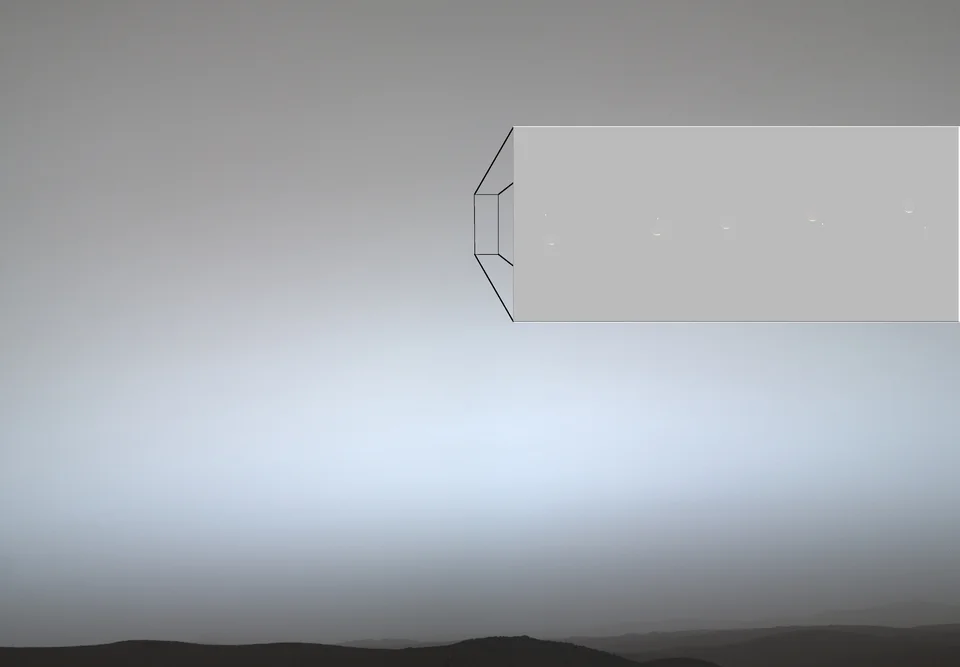
- The annotated inset puts successive exposures side by side so the changing alignment can be followed.
Inside this story 2 perspectives
In the middle of a sequence photographed from Mars, a bright speck disappears. The foreground object is Phobos, the larger Martian moon. The speck is Earth. NASA released the images on 5 August and described them as the first observation taken from the surface of another planet of our own world passing out of sight behind an object.
The Perseverance rover recorded the encounter on 2 July, at about seven in the evening by local solar time. It was looking up from the rim of Jezero Crater. Earth lay roughly 314 million kilometres away and registered as a point about a pixel across. No continent can be picked out at that scale. The evidence that the speck belongs to our planet comes from where the camera was pointed and how the two objects moved across successive exposures.
Five moments in one strip of sky
The annotated image can look puzzling at first. It shows a row of crescents, each with a slightly different arrangement of light around it. There is only one Phobos in this observation. The image team placed five views of the same patch of sky side by side, in time order, inside a larger composite. Reading from left to right is a way of advancing the clock.
Earth appears to move down and to the right while Phobos moves the other way. In the third view their paths overlap and the dark edge of Phobos hides the distant light. A later frame records it again. The Jet Propulsion Laboratory also released a separate composite with light removed from its background to make faint detail more visible. The dark background in that version is a processing choice. It tells a different part of the story from the broader view of the Martian horizon.
A small moon can cover a planet
Phobos is only about 27 kilometres across at its widest. Nevertheless, from the rover’s position it had appreciable width in the sky, while the vastly more distant Earth did not. Astronomers call this an occultation. Whether it is visible depends on where the observer is standing. A camera elsewhere does not automatically see the same event.
The Mastcam-Z system gives Perseverance a pair of camera eyes with adjustable focus and zoom. Arizona State University’s instrument team describes tiny motors repositioning the lenses to change the field of view. But optics alone cannot deliver this portrait. The team had to anticipate an alignment, select a stretch of sky and capture several moments on either side of the disappearance. The dot returning in the last frames is as valuable to a reader of the picture as the moment it vanished.