- NASA announced 19 citizen science proposals across two programmes on 28 October.
- Overlap Zoo uses light from a background galaxy to study dust in a foreground one.
- Volunteers verify candidate pairs and mark features that determine their scientific value.
Inside this story 2 perspectives
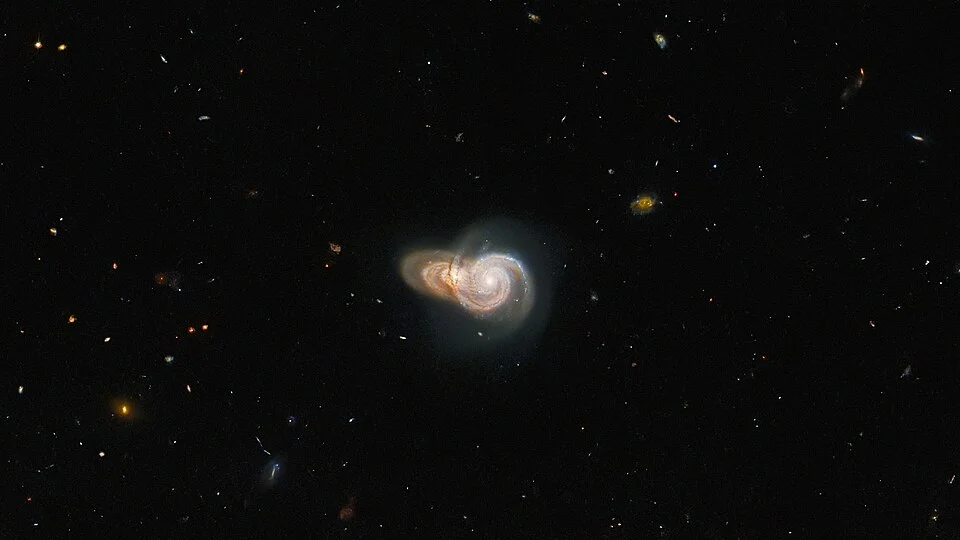
Astronomers have an unusual use for a galaxy that appears in the way of another one. Its position can turn a distant neighbour into a source of backlighting. Dust in the nearer galaxy blocks some of that light, making it possible to study material that is hard to isolate when every visible star appears against a dark background.
On 28 October NASA announced 19 citizen science proposals selected across two programmes. Among them was Overlap Zoo, led by Benne Holwerda of the University of Louisville. It was one of twelve selections in the agency’s seed funding programme. The other seven teams in the wider announcement came through its Science Activation programme. The research team had already invited volunteers to start examining Overlap Zoo images in September.
The arrangement that makes the method work is a matter of perspective. Galaxies that share part of an outline in a telescope image need not be colliding or even close neighbours in space. An observer looking along the same line of sight can see part of the nearer galaxy in front of light from the more distant one. A physically unremarkable alignment can be a particularly informative observation.
Where a volunteer comes in
A different Galaxy Zoo project had already helped identify pictures that might contain overlaps. The new task asks a volunteer to examine each candidate more closely. Is there a pair? What features are visible in each galaxy? Where should each outline be drawn? These judgments help researchers decide which systems are suitable for a closer analysis of dust.
Some images will offer a clearer comparison than others. A useful case has a region where the galaxies overlap and enough information elsewhere to estimate the background light. The darker patch in one picture still needs interpretation. How much light would the more distant galaxy have supplied there if the foreground dust were absent? Picking pairs where researchers can make a reasonable estimate is part of the science.
What a larger catalogue could show
Dust affects the light astronomers receive and consequently the estimates they make about a galaxy’s stars. A map of how much light disappears across one galaxy provides a starting point. Measurements in many systems can test whether the same correction works across different environments. The team says it remains uncertain whether a universal rule for the light lost to dust will describe them all.
That is a useful boundary for the volunteer's job. Marking an outline does not by itself measure a dust mass or establish a general rule. It makes one image more intelligible to the researchers assembling the sample. A collection of carefully described chance alignments can then support a question too large for any single pair to answer.