- A study published on 2 November combined experiments and simulations of nanoparticle assembly.
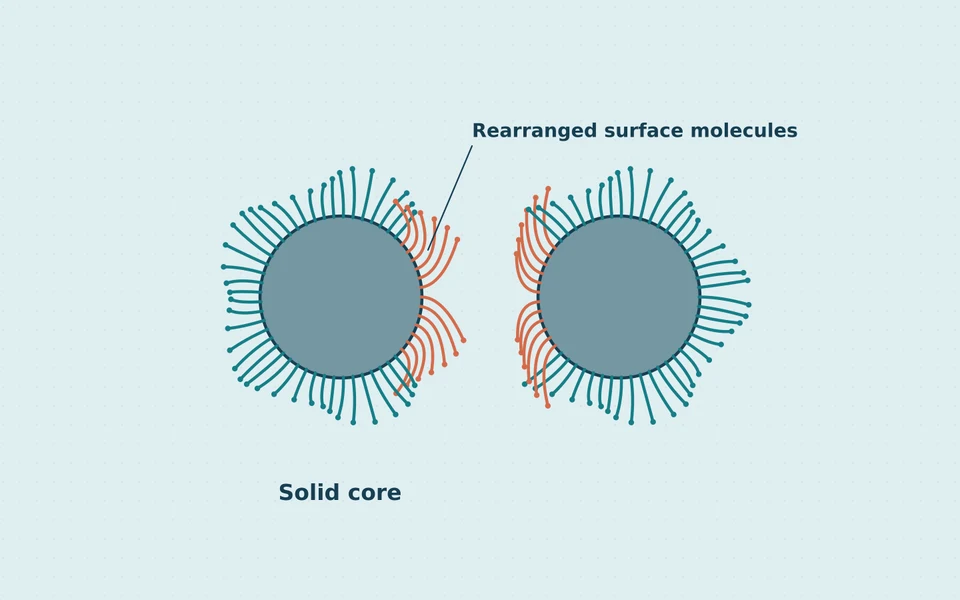
- Flexible surface molecules rearranged near contacts, giving particles an effective preference for certain numbers of neighbours.
- The resulting structures can have lower coordination, density and symmetry than close-packed spheres would suggest.
Inside this story 2 perspectives
Imagine packing identical hard balls into a box. Their shape places limits on where their neighbours can sit, and close packing gives each ball many points of contact. Now give each ball a surface coating that can move and bend when another ball approaches. The preferred arrangement may change even though the hard core looks the same from every direction. Researchers at MIT and partner institutions have shown that the flexibility of such coatings can help determine the structure of a nanoparticle crystal.
The study appeared in Nature Materials on 2 November. Using experiments and simulations, the researchers examined particles surrounded by flexible, electrically active molecular chains. They found that the chains can rearrange where two particles meet. This changes the number and arrangement of neighbouring particles that the system favours as it assembles.
An instruction that appears at the contact
One approach to designing a crystal is to build its intended directions into the particles first, for example by giving each particle an uneven shape or placing bonding sites at particular positions. The team investigated a different possibility. A particle that starts out equivalent in all directions can develop an effective preference for certain contacts when its coating responds to the neighbouring particles.
The paper calls this emerging property a valency, meaning the number of connections a particle effectively makes in the assembled structure. As the coating becomes more deformable, molecules can line up near an interface with another particle. The experimentally relevant object is then more than a hard centre of a particular size. Its interactions depend on the molecules around it and on what is already nearby.
Count the neighbours before predicting the use
The researchers found that greater deformability could lower the number of neighbouring particles. They used particle sizes and the lengths of the molecular chains to control connections and studied structures with lower packing density and symmetry than a picture based on hard spheres would predict. These results provide a way of testing competing descriptions of the assembly: does the preferred structure follow from the core geometry alone, or does the coating have to be allowed to rearrange?
Materials scientists are interested in such structures because the arrangement of components can change the properties of the finished material. An application in optics or electronics would still require a material that performs a specified task under relevant conditions. The present experiment demonstrates a design variable that helps reach arrangements that would otherwise be hard to obtain. In this case, the property that made the final structure more controllable was the freedom of the connectors to move.