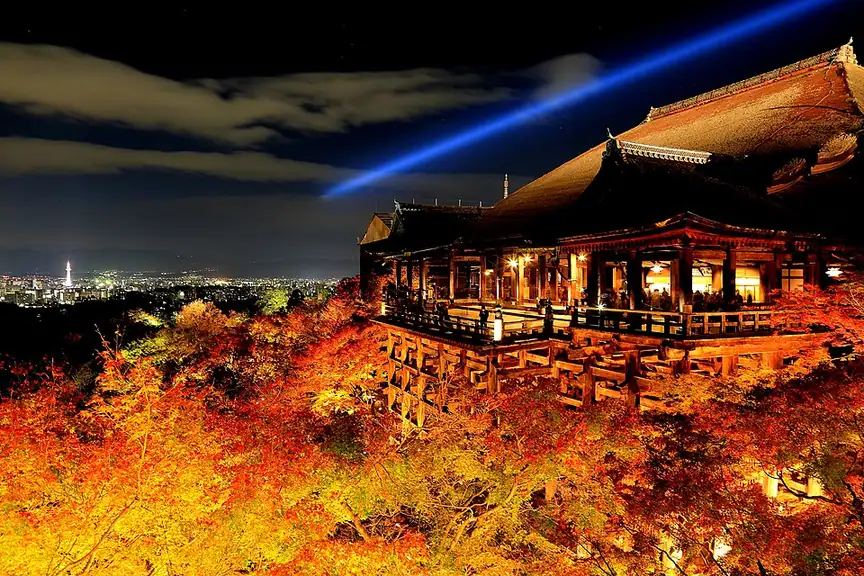
- Kiyomizu-dera was at peak colour on 25 November, while nearby Kodai-ji was still approaching its peak.
- The temple’s evening viewing ends on 30 November. Arrive before the 9pm entry cutoff for a 9:30pm close.
- Okunoin Hall offers a second vantage point over the hillside and back towards the main stage.
Inside this story 2 perspectives
There are two clocks to watch at Kiyomizu-dera this week. One belongs to the maples on the hillside above Kyoto. Japan Guide’s observer visited on Wednesday, 25 November, and found them at peak colour. The other belongs to the temple. Its autumn evening opening runs through Monday, 30 November, with the last visitors admitted at 9pm and the grounds closing half an hour later.
The distinction is worth carrying on the walk up through Higashiyama. A spell of cool weather hastened the change in the leaves, according to the field report. Just along the same side of Kyoto, Kodai-ji still had trees approaching their peak on Wednesday. There is no single evening when an entire city turns red, and the end of a temple’s lighting programme says little about the colour a visitor might find there the next morning.
Look back at the stage
Kiyomizu-dera’s wooden stage extends from the main hall some 13 metres above the hillside. The trees below have a way of reversing the usual experience of looking up into a canopy. Here visitors can look down into the branches, then beyond them towards a much flatter, built-up Kyoto. On Wednesday the colours in the valley still included greens and yellows beside the red.
There is a second way to see the structure. From the smaller stage at Okunoin Hall, further along the route, turn back towards the main hall. The platform that felt like solid ground a few minutes earlier becomes a remarkably exposed piece of timber construction at the edge of a slope. Visitors who have time to see the place before dusk can watch that relationship change as the hillside darkens and the lights reach the leaves.
The blue light above Kyoto
The beam stretching into the night sky has a specific meaning at Kiyomizu-dera. The temple describes it as an expression of the compassion of Kannon, the Buddhist figure honoured in the main hall. Water gives the place its name. Founded in 778 by the Otowa waterfall, the temple is known in English as the Pure Water Temple. The falls are down the slope from the main hall, another reason to allow time beyond the first view from the stage.
The approach through Higashiyama’s shopping lanes is uphill. Someone counting on those final thirty minutes between last admission and closing would spend much of the evening getting from one viewpoint to the next. An earlier arrival leaves room to linger at one of them, cross to the other, and recognise the same cluster of trees from an entirely different height.