- Guinea is seeking finance for a proposed multi-user port south of Kamsar.
- Direct ship loading could reduce barge transfers for bauxite exporters.
- Smaller businesses would also need dependable berths, road access and transparent charges.
Inside this story 2 perspectives
South of Kamsar, on Guinea’s Atlantic coast, the government wants to build a port where a bauxite producer and a container importer could use the same stretch of waterfront. That pairing gives the proposed M’Bottiny port much of its economic interest. A mine can bring the volume that helps finance an expensive harbour. What happens to the trader’s cargo once the mine arrives is a different question.
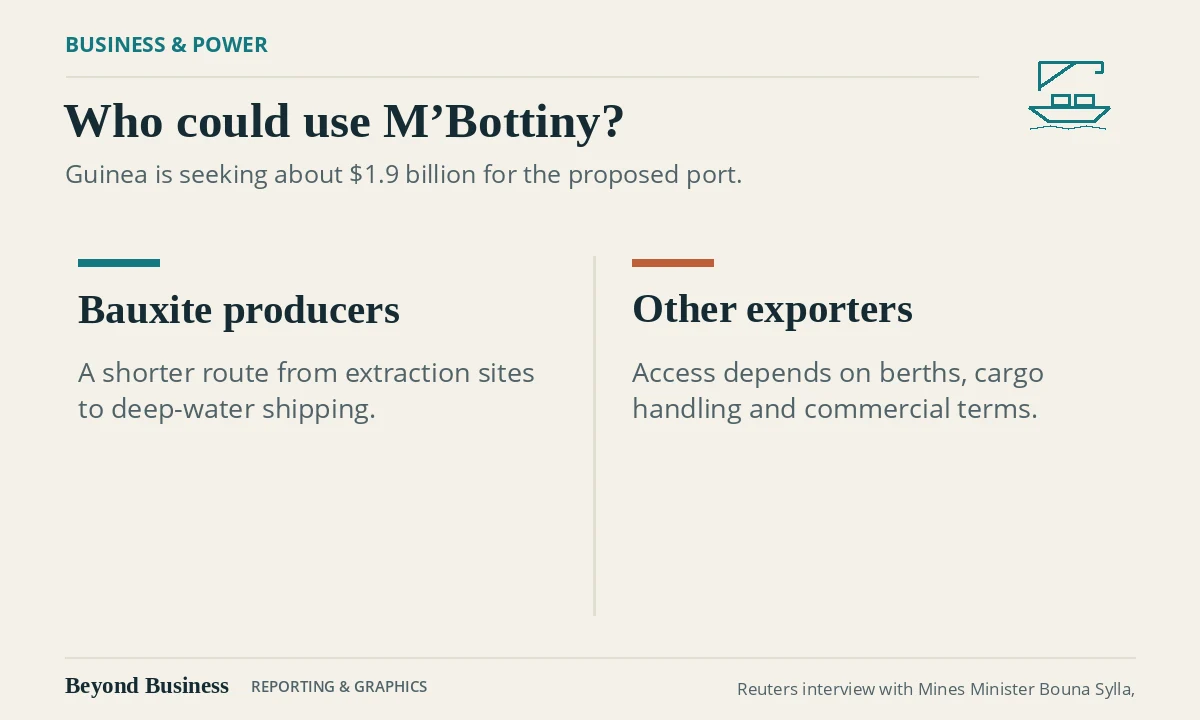
Mines and Geology Minister Bouna Sylla told reporters on 16 November that Guinea was seeking about $1.9 billion for the project. He said feasibility studies were complete and the government had approached prospective financiers including Chinese and US interests and multilateral institutions. Those discussions establish a search for capital. They leave open who will fund the port, what each participant will contribute and on what terms.
What deeper water would change
Sylla described a plan that would allow large bulk carriers to take on cargo directly. Today, some bauxite from the Boké area goes out by barge and is transferred to bigger vessels offshore. Direct loading could remove a handling stage. A mining company considering the port would compare that saving with the cost of getting ore to the quay and the fees it would pay there.
Guinea already has a useful point of comparison. In December 2025, SimFer announced that its first Simandou iron ore shipment had left Moribaya in Forecariah, following the ore’s journey by rail. That was a different port and a different mineral. Its significance here is the way a large export project can organise an entire transport chain around one commodity. M’Bottiny would have to accommodate customers with quite different rhythms.
A berth for the smaller shipment
The proposed design includes a container terminal and an industrial park. Picture a manufacturer deciding whether to set up nearby. A container of spare parts may be tiny beside an ore shipment, yet a late part can stop a production line. For that business, the attraction is a predictable unloading slot, a road it can use and storage at a price it knows in advance. The water depth alone cannot deliver any of those things.
For the public authorities negotiating with investors, that makes access rules worth discussing as early as construction costs. Who sets charges? Can cargo owners see a timetable? When space is tight, can a smaller customer challenge a decision that leaves its container sitting at the quay?
The answers would help distinguish two possible futures for the same harbour. In one, Guinea moves more mineral tonnage efficiently. In the other, it achieves that and gives a wider group of businesses a dependable way into regional trade. The government’s financing conversations are the moment to put a price and a timetable on both ambitions.