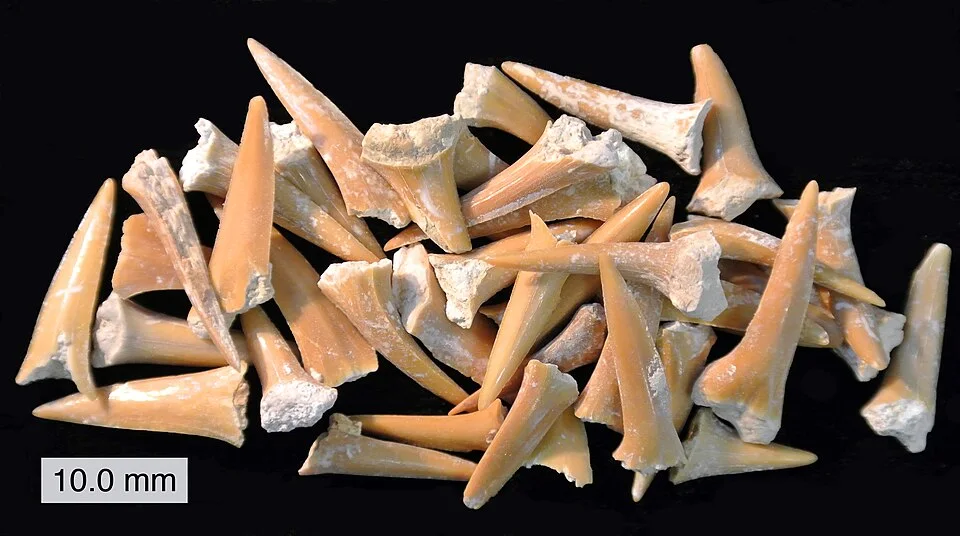
- Researchers examined 14 teeth collected at Abu-Tartur in Egypt’s Western Desert.
- The study adds at least five species to two already reported from the area.
- A deposit that accumulated slowly can bring together fossils from animals that lived at different times.
Inside this story 2 perspectives
One tooth is slim and pointed. Another has a broad, triangular blade with a serrated edge. Found together in a phosphate bed in Egypt’s Western Desert, such differences offer an inventory of animals that once swam above what is now dry land. The challenge is working out which edges belong to which sharks, and how much of an ancient sea a handful of teeth can recover.
Tarek Yassin and colleagues report at least five additional species of extinct mackerel sharks from the Abu-Tartur Plateau. Their paper appeared online in Cretaceous Research on 18 August. The researchers collected 14 teeth from the surface of a phosphate bed in the Duwi Formation and compared them with published descriptions and museum specimens. Earlier work at the site had identified two kinds of mackerel shark. The new collection brings the area’s reported total to at least seven.
The small print of a tooth
A list in a research paper can look more final than the scientific judgment behind it. Several identifications here carry the abbreviation “cf.”, a signal that the specimen compares closely with the named species. A shape can be sufficiently distinctive for a useful comparison while one or two features, or the condition of a fossil, leave room for doubt. Preserving those qualifications matters when a single tooth could move a recognised species into a new part of the world.
One especially intriguing comparison is with Scapanorhynchus raphiodon, an extinct relative of the goblin shark. Such an identification would extend its known record to Africa and may represent an unusually late occurrence. More specimens could clarify whether that conclusion holds. Adding a name to a map requires a geographic judgment and an anatomical one. Pushing its last appearance forward in time adds a further demand on the dating of the rock.
The clock inside the rock
The beds at Abu-Tartur formed when a warm sea covered the region during the Late Cretaceous. They accumulated under conditions favourable to phosphate formation. A seafloor receiving little sediment over a long period can collect material shed by many generations of animals. By the time that material becomes a bed of rock, events far apart in a shark’s lifetime can look close together in a geologist’s section.
That makes it difficult to picture these seven species sharing a single patch of water on a particular afternoon. It also makes the deposit valuable for a different reason. A field team working with a small collection has recovered several shapes of predator from the same broad marine setting. Fourteen teeth cannot give a census of that sea. They do give the next researcher a detailed set of comparisons to test when another tooth appears in the phosphate.