- Chandra and eROSITA detected hot gas surrounding a radio source nearly hidden behind the plane of our galaxy.
- Researchers interpret the structure as old material from a black-hole outburst revived during a cluster merger.
- Composite images assign colours to different wavelengths so that astronomers can compare what the instruments detected.
Inside this story 2 perspectives
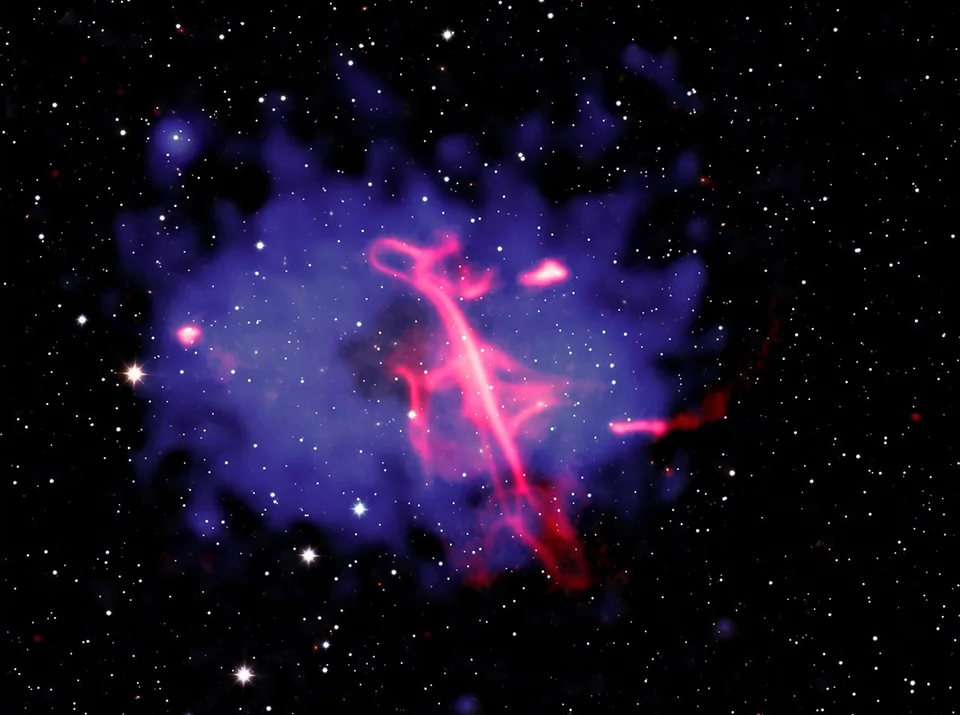
A bright curl on a radio map resembles a musical treble clef closely enough to have acquired the name. The resemblance helped astronomers describe where to look. It offered little guidance about the kind of object they had found. On 14 October NASA released a composite image and an account of how an international team traced the radio structure to a pair of merging galaxy clusters.
The object lies almost directly behind the plane of the Milky Way as viewed from Earth. Stars, gas and dust in our own galaxy make it hard to see what is happening beyond them. An early interpretation even placed a pulsar behind the radio signal. Andrea Botteon and colleagues instead combined observations at several wavelengths to examine both the signal and the environment around it.
Look around the curl
Chandra and eROSITA, which observe X-rays, detected diffuse hot gas in the same part of the sky. Galaxy clusters contain large reservoirs of such gas along with the galaxies themselves. The researchers found evidence of two clusters in the process of merging. That supplied a setting in which the odd radio source could be examined, even though visible light alone gives a poor view through the foreground of our own galaxy.
The composite image uses red for radio observations from the LOFAR telescope network and blue for the X-ray-emitting gas. Infrared observations add another view of the field. These colours let viewers locate different signals relative to each other. A person looking in the same direction would not see a red symbol hanging against a blue cloud. What matters scientifically is that the radio structure belongs in a region where the gas itself is disturbed.
An old signal gets another turn
The team proposes that an outburst from a supermassive black hole first sent energetic particles and magnetic fields out into the surrounding cluster. As the particles lost energy, the radio emission faded. Later, motions associated with the cluster merger disturbed this old material and helped make it visible again. Astronomers use the term radio phoenix for a source in which previously faded emission is revived.
Which motions produced each twist in the structure remains an interpretation. The paper identifies observations at lower radio frequencies and higher resolution as a way to investigate the filaments further. That distinction between image and history is part of the fascination here. Several telescopes have recorded an arrangement of light arriving now. From that arrangement, the researchers have reconstructed a plausible sequence in which a black hole and a much larger collision made their marks at different times.