- The July images mark four years of Webb science.
- Near- and mid-infrared observations reveal different features of the same galaxy.
- The origin of the S-shaped structure remains open.
Inside this story 2 perspectives
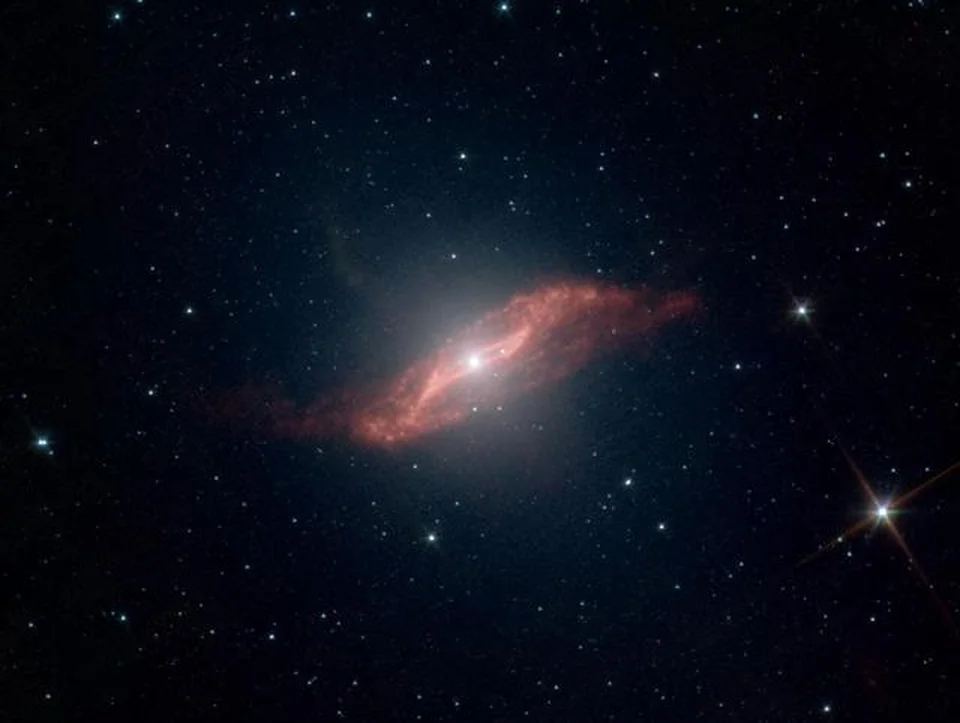
In a visible-light portrait of Centaurus A, a dark band crosses the brightest part of the galaxy. For anyone trying to study its centre, that band is an obstruction. Switch to one of the James Webb Space Telescope’s infrared views and the dust itself becomes a subject. It shines in an elaborate pattern, including a curve that resembles the letter S. Astronomers can trace that shape much more confidently than they can explain what made it.
The European Space Agency returned to Centaurus A in its 31 July review of the month. The images themselves were released on 6 July to mark four years of Webb science. Their interest lies partly in the choice of target. About 11 million light-years from Earth, this comparatively close galaxy has both a busy central black hole and a past collision. That gives observers a rare chance to examine the consequences of two powerful processes in the same neighbourhood.
Two instruments, one patch of sky
Dust absorbs and scatters some of the light that would otherwise reach a telescope. At near-infrared wavelengths, Webb can pick out individual stars behind parts of the obscuring material. In the mid-infrared view, much of the dust glows. In one frame the observer can investigate a population of stars. In the other they can follow the shape of dust around them. Moving from the first to the second changes which pieces of the galaxy stand out.
The difference becomes particularly interesting near the core. A supermassive black hole is taking in matter there, and jets emerge from its vicinity. Elsewhere are signs of a merger with another galaxy roughly two billion years ago. Both a collision and activity around a black hole can disturb the material from which stars form. Simply seeing new stars alongside disturbed gas cannot, by itself, establish which process mattered most at that spot.
A picture with an open question
The S shape in the mid-infrared image gives researchers somewhere to direct their attention. Could energy from the centre shape it? How much could ongoing star formation, set in motion by the past collision, explain? The team presents those as questions for further study. Anyone reading the image caption has the unusual privilege of meeting a striking feature before there is an agreed story attached to it.
There is another reward in looking back at older images. Hubble’s view makes the dust lane obvious. The retired Spitzer telescope could see large infrared structures while leaving many stars unresolved. Together the images show why the same object can repay decades of observation. Each instrument keeps a different part of the evidence. For a reader opening the anniversary gallery, it is worth moving between the views before settling on a favourite. Watch what vanishes as well as what appears.