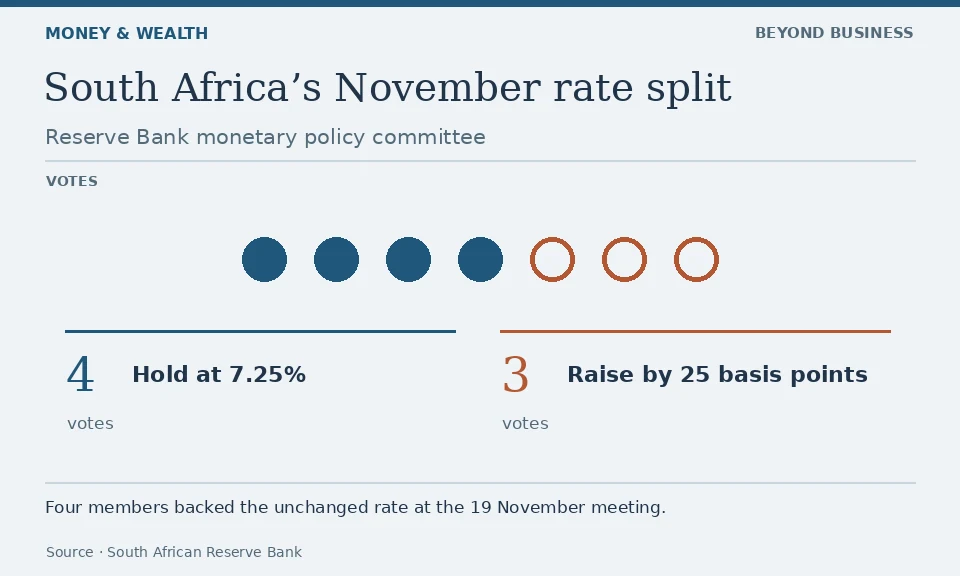
- The repo rate remains 7.25% after a four-to-three vote.
- The Bank’s model and private-sector forecasts are conditional, not commitments.
- Budget against actual borrowing terms and test more than one rate scenario.
Inside this story 3 perspectives
South Africa’s Reserve Bank left its policy rate at 7.25% on 19 November, giving borrowers a pause after two increases this year. The close vote matters as much as the unchanged number: four members supported holding, while three preferred another quarter-point rise.
For anyone preparing a household or business budget for 2027, this is breathing room rather than a reliable signal of cheaper credit ahead. An unchanged policy rate does not settle what happens next to inflation, lending conditions or the rand.
Why the pause is cautious
The Bank’s statement describes a policy stance already restraining demand, but identifies risks from fuel, the exchange rate and weather. Its projection model points towards lower rates next year. The Bank explicitly treats that path as guidance, with actual decisions made meeting by meeting. A model is not an undertaking to borrowers.
Independent reporting by IOL puts the decision in the context of October’s 5.2% annual inflation rate, up from 4.5% in September. It also reports a prime lending rate of 10.75%. Prime and the repo rate are different: the former is a commercial lending reference, while the latter is the central bank’s policy rate. An individual loan’s price depends on its contract.
The forecast disagreement is instructive
The IMF’s 20 November Global Markets Monitor describes two different bank views. Goldman Sachs added a January increase to its forecast and moved expected cuts further into 2027. Barclays still expected no further increases, while acknowledging risks. These are dated forecasts reported by the monitor, not settled outcomes or Beyond Business predictions.
That disagreement is useful information. It means a budget built around one confident forecast may be more fragile than it appears. The question is not simply which economist will be right, but whether a plan can withstand being wrong about the timing.
What the decision means in practice
For a business assessing equipment finance, the sensible comparison is the full repayment schedule under its actual terms. For a household, it is the effect on disposable income after regular expenses. Neither calculation requires guessing the next meeting correctly. Both benefit from separating current obligations from hoped-for savings.
For readers elsewhere in Africa doing business with South Africa, a policy-rate headline is also only one piece of a transaction. Financing currency, payment timing and exchange-rate exposure can matter as much as the domestic interest-rate decision. There is no single borrowing cost that applies across the region.
The next scheduled decision is 28 January 2027, according to the Bank. Until then, the most useful distinction is between what has happened and what is projected: rates have held; a sustained easing cycle has not been promised. That distinction deserves a place in every forward budget.