- A camera recorded changing patterns of light leaving a stationary fibre.
- A magnetic field across the fibre produced a measurable change.
- A sensor based on the result would still need calibration and testing.
Inside this story 2 perspectives
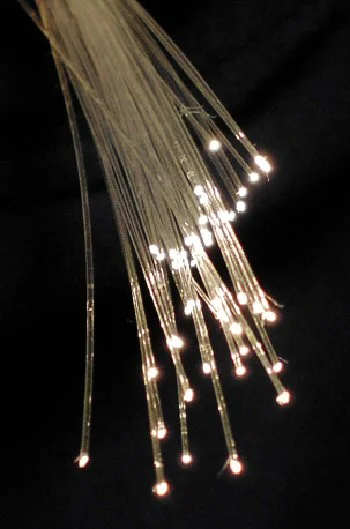
Mohammed Raiyan Sharif and Mitchell Cox kept the optical fibre still. They put strong magnets beside it, without touching the glass, and watched the light at the far end with a camera. When they rearranged the magnets, the pattern of bright and dark spots changed. Something a familiar model allowed engineers to ignore had become visible in a laboratory in Johannesburg.
The University of the Witwatersrand described the work on 11 November. Sharif, a master’s student, and Cox, a professor, reported the findings in Optics Letters. The result concerns multimode fibre, a type of optical fibre in which light can travel along several paths. When those contributions meet at the output, they produce the spotted pattern the researchers recorded. The apparently untidy pattern was the measuring instrument’s most valuable clue.
A magnet pointing in an unexpected direction
Glass and magnetic fields have a long history together. In the conventional Faraday effect, a magnetic field along the direction of the light’s travel can rotate its polarisation, the orientation in which the light oscillates. Engineers use that relationship to sense magnetic fields and electrical current. A field pointing sideways across an optical fibre seemed a less promising place to look.
The convenient approximation used to describe light in the fibre leaves out a small component of the field of the light itself. For many purposes that is a reasonable bargain. A calculation can be more manageable and still describe the observation the engineer currently needs. In the Wits experiment, however, the omitted component provided a way for the sideways magnetic field to influence the light. The team could see the effect in the pattern produced by the combined paths.
From a changing picture to a dependable instrument
There is considerable engineering distance between seeing that a pattern changes and selling a sensor. For a customer who needs a measurement, a brighter spot is only the beginning. A device must report a value with known uncertainty. Its designers have to establish what else might alter the picture and whether a second instrument returns a comparable result under similar conditions.
Those questions give the result its practical interest. If the effects of different field directions can be distinguished reliably, a designer may be able to use information that an older calculation discarded. What can be claimed now is narrower and particularly appealing. The researchers used a familiar material, a camera and an experimental arrangement designed to make a usually overlooked contribution matter. The fibre that carries messages for a living may also be able to tell engineers a little more about the space immediately around it.