- Epsilon Eridani b is a possible target for Roman’s coronagraph.
- Astronomers have detected the planet indirectly through changes in the light of its star.
- The instrument is a technology demonstration and a successful observation is uncertain.
Inside this story 2 perspectives
What would count as a good picture of a planet ten light years away? For a team preparing an experiment on NASA’s Nancy Grace Roman Space Telescope, one faint dot would do. A possible target, Epsilon Eridani b, is a giant planet whose existence astronomers have inferred from the light of its star. Recovering a little of the planet’s own reflected light would give them a different observation of the same system.
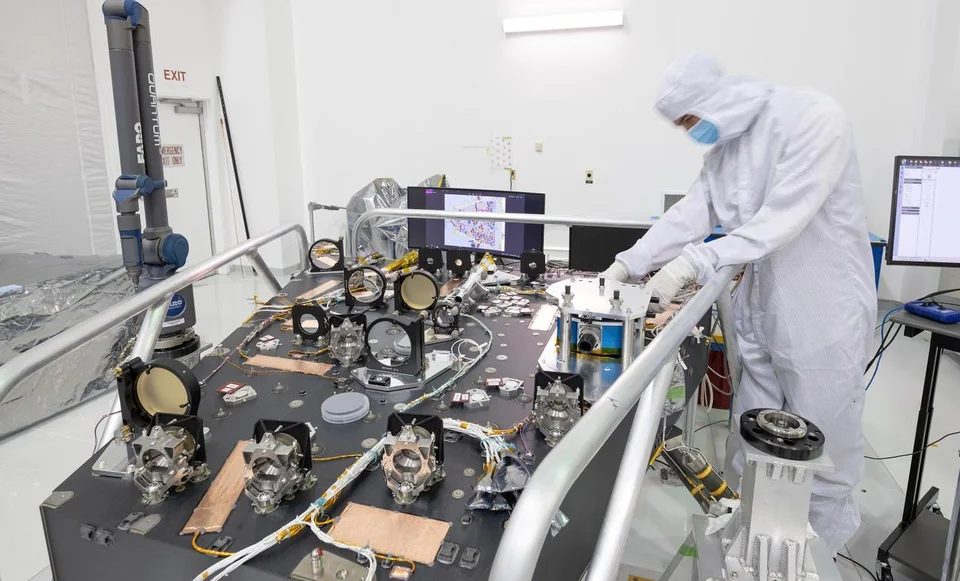
On 27 August, Cornell described the work of Dmitry Savransky and colleagues who have helped choose targets for Roman’s coronagraph and identify promising times to look. NASA is targeting an August 30 launch for the observatory. The coronagraph is a technology demonstration. Even for a nearby planet with a known orbit, the team does not yet know whether the instrument can separate a planetary signal from the glare around it.
The star has already given away a secret
A planet and its star pull on each other through gravity. A telescope can find evidence of that interaction through small changes in the light from the star as it moves. Cornell reports that ground-based measurements of this kind revealed Epsilon Eridani b. They offer information about a planet even when the observer has never isolated any light that came from the planet.
For a direct observation, the star changes from a helpful signal into a formidable neighbour. Its light is far brighter than the faint reflection from a planet close beside it in the sky. The coronagraph uses masks, sensors and mirrors whose shapes can be adjusted to suppress that glare. The timing also matters. A target at an unfavourable point in its orbit can appear too close to the star for the instrument to distinguish the two.
What can fit inside a point of light
A successful picture would scarcely resemble a postcard of Jupiter. The atmosphere, clouds and visible surface markings a viewer might imagine would be much too small to separate in the image. Yet light concentrated in one dot can still carry information about the atmosphere that reflected it. The experience of extracting that light also tells engineers how to design a future instrument for a fainter planet.
Roman’s main survey work uses a separate wide-field infrared instrument. The smaller experiment asks what can be learned by concentrating on a few specially chosen targets. Some young, hot exoplanets have already been imaged from the ground in infrared light. The ambition here is to reach older, cooler worlds in circumstances where a bright host star makes them especially difficult to see. The first achievement would be modest to the eye and substantial to the people who had to know exactly where to look.