- Sales for the financial half-year rose 7.6 per cent in euros and 9.2 per cent at constant exchange rates.
- The subsequent 9 per cent figure covered store and online sales from 1 August through 7 September at constant currency.
- The half-year gross margin reached 58.7 per cent, while net income grew 6.8 per cent.
Inside this story 2 perspectives
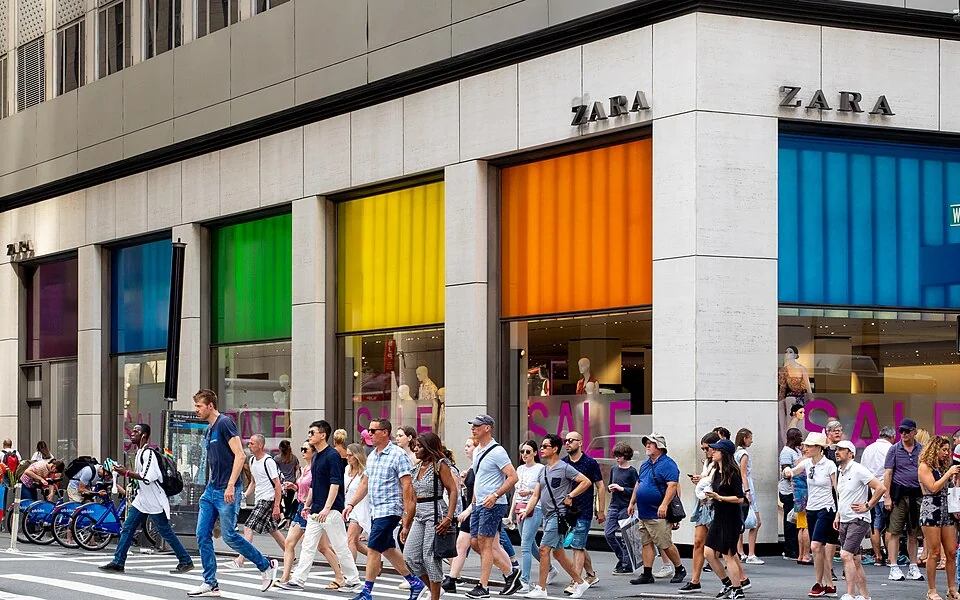
A dress sold by Zara outside the euro area has two prices of interest to an investor. Its customer pays in local currency. Inditex, Zara’s parent, eventually reports the sale in euros. The exchange rate connecting the two can change without any change at the checkout. That complication matters in the half-year figures the Spanish retailer published on 9 September, particularly for anyone trying to read the first weeks of autumn as a change of pace.
Inditex reported €19.8 billion in sales for the first half of its financial year, up 7.6 per cent. On the company’s constant-currency calculation, the increase was 9.2 per cent. It also reported that store and online sales from 1 August to 7 September were 9 per cent higher than in the corresponding period of 2025, again measured at constant currency.
What belongs beside nine?
The 7.6 per cent figure and the 9 per cent update make an appealing pair of headlines. Comparing them directly, however, mixes exchange-rate effects with a change of reporting period. The closer comparison is 9.2 per cent for the half-year and 9 per cent for the shorter period. Even that comparison leaves different seasons, lengths of time and collections in the frame. It offers a first reading on customer demand while leaving most of the autumn and winter season ahead.
The accounts cover the group, which includes other brands alongside Zara. They also combine activity in stores and online. Knowing the overall increase does little to identify which part of a particular store was responsible, or whether more customers bought items, different items sold or the prices paid changed. Those questions require additional detail.
The money left after the clothes
Gross profit rose 8.3 per cent to €11.6 billion, and the gross margin reached 58.7 per cent. A rise of 40 basis points means four-tenths of one percentage point. For every €100 of sales, that measure left around 40 cents more after the cost of the goods than a year earlier. Gross profit still has to cover the other costs of running a retailer.
Operating expenses also increased 8.3 per cent. Net income rose 6.8 per cent to about €3 billion. The order matters for a shareholder reading the results. An improvement in the proportion remaining after the goods are paid for does not require the final profit line to grow at the same rate.
The company ended the half-year with 5,444 stores and reported work on its store network in 51 markets. Across a group of that scale, one percentage can be accurate and answer a very small question. Pair it with the relevant currency, date range and line in the accounts, and it becomes a much more useful guide to what customers actually did.