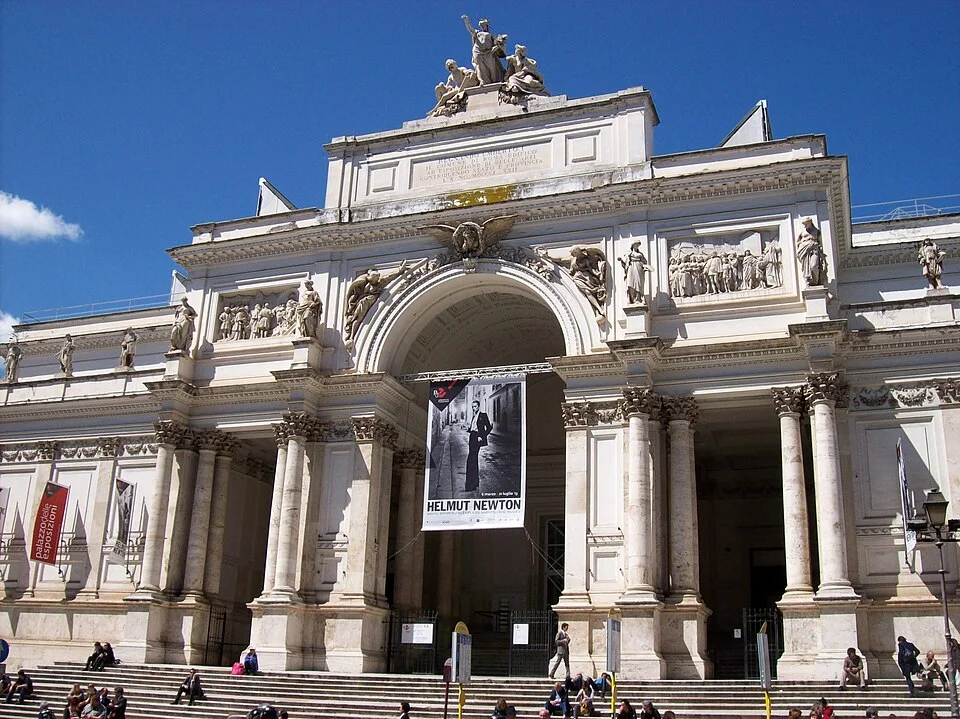
- Fireworks opens at Palazzo Esposizioni Roma on 3 November.
- Curator Mario Codognato brings together works by 35 artists Sonnabend exhibited.
- The temporary show complements a permanent collection on view in Mantua.
Inside this story 2 perspectives
Robert Rauschenberg’s Kite and Roy Lichtenstein’s Wall Explosion II are on the list of works in a new Rome exhibition. The name above the door belongs to neither artist. Fireworks, opening on 3 November at Palazzo Esposizioni Roma, puts the gallery owner and collector Ileana Sonnabend at the centre of an account of how contemporary art travelled between Europe and the United States.
Curated by Mario Codognato, the exhibition brings together works by 35 artists whom Sonnabend exhibited. Among them are Jasper Johns and Andy Warhol, as well as Mario Merz, Jannis Kounellis, Giulio Paolini and Gilbert & George. The dates span different movements and generations. What makes them comprehensible alongside one another here is a series of decisions about whom to show, where to show them and which audience might be ready to look.
Sonnabend opened a gallery in Paris in 1962 and later operated galleries in Geneva and New York. In Europe she presented American artists including Johns, Jim Dine, Warhol and Lichtenstein. Across the Atlantic she helped introduce artists associated with the Italian Arte Povera movement to audiences encountering different materials and ideas about what a work of art could be.
Look at the direction of travel
The familiar shorthand for the period makes New York the starting point and Europe the recipient of new American art. Sonnabend’s exhibition history is more interesting as a set of journeys in both directions. A viewer who arrives for Warhol’s Nine Jackies can follow the connections back across the Atlantic to the work of Merz or Kounellis. Their proximity in the programme points to an organiser willing to make room for very different forms of ambition.
Rome has its own stake in that story. Rauschenberg and Cy Twombly were among the Americans whose careers also brought them to the city. The geographic labels attached to artists become much less tidy once one follows where people worked, where their pictures travelled and who encountered them there.
What a collection can preserve
After Sonnabend died in 2007, a foundation was established to keep a core of the collection together. Part of that legacy has been on permanent display at Mantua’s Palazzo della Ragione since 2025. The temporary Rome exhibition, which runs until 4 April 2027, draws on foundation holdings, the Sonnabend Homem Collection and other public and private lenders.
Seeing individual works in a museum can make their public lives seem inevitable. This exhibition makes a less visible decision available for scrutiny. At a particular moment, someone found a room, chose what would share its walls and invited another audience in. The works have long since acquired famous names. Rome is giving the choices that brought them together a history of their own.