- The public run of the Bangkok Art Biennale began on 29 October.
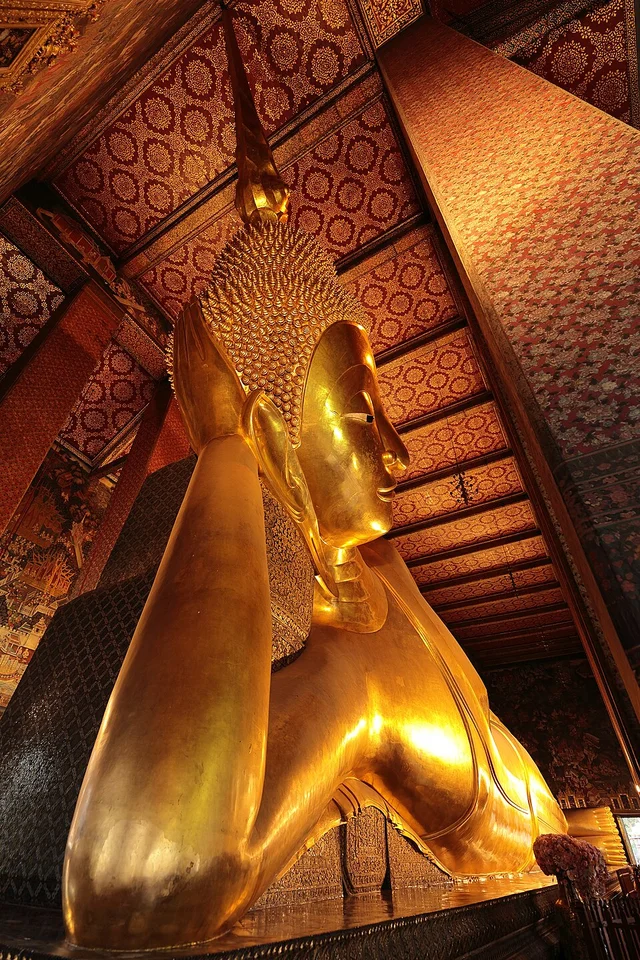
- At Wat Pho, Leiko Ikemura’s Memento Mori connects a reclining bronze figure with two sculptural traditions.
- At the National Museum, Liu Jianhua uses steel and glazed porcelain in a site-specific installation.
Inside this story 2 perspectives
A reclining body takes its meaning partly from where it lies. Seen in a European funerary sculpture, it may suggest a memorial figure. Seen at Wat Pho in Bangkok, the pose inevitably calls to mind the temple’s monumental Reclining Buddha. Leiko Ikemura’s bronze Memento Mori brings those two references into the same setting for the fifth Bangkok Art Biennale, which opened to the public on 29 October.
The biennale’s theme is Angels & Mara, and the programme extends to eleven venues, including temples, museums, cultural institutions and commercial spaces. That variety could make the event sound like a long itinerary. The encounter at Wat Pho offers a more specific reason for moving between sites. The meaning visitors give a contemporary sculpture can begin with an older work they already know and with the conventions that govern the place they find themselves in.
A pose remembered in more than one tradition
In the venue’s description, Ikemura’s work draws together mortality, rebirth and Buddhist imagery. The title evokes the European reminder that human life ends. The reclining pose can be read through another visual tradition in the temple. The comparison does not require those traditions to mean the same thing. Their differences are part of what a viewer can notice when a familiar position of the body travels from one context into another.
The programme also identifies two nearby works, Wu-san and Ma-san, associated with an angel and a devil from Cologne. Read alongside the reclining figure, their presence complicates any expectation that the biennale theme will divide every work neatly into good and evil. A visitor may bring religious, personal or art-historical associations to the names before encountering anything the artist has made. The site gives those expectations room to meet.
A museum changes the materials in view
At the National Museum Bangkok, Chinese artist Liu Jianhua’s Square (Siamese Triangle) takes a different approach. Its installation of steel and glazed porcelain was devised for the Throne Hall. The materials and their arrangement enter an environment already associated with national collections and the display of history. A person who saw these elements reproduced on a screen would have access to the objects’ appearance but much less of the setting against which the work is read.
The organisers list more than 200 works by 72 artists representing 29 nationalities. The scale makes it unlikely that any two visitors will construct exactly the same route. For a reader considering where to start, Wat Pho and the National Museum offer a manageable pair. Each asks what contemporary art can do when its surroundings already have something to say.