- The researchers allowed climate and ice sheets to evolve together in a series of long simulations.
- More snowfall and cloud cover moderated ice loss over the East Antarctic interior.
- The model could not resolve all local ocean and glacier processes, and its results are not a forecast for this century.
Inside this story 2 perspectives
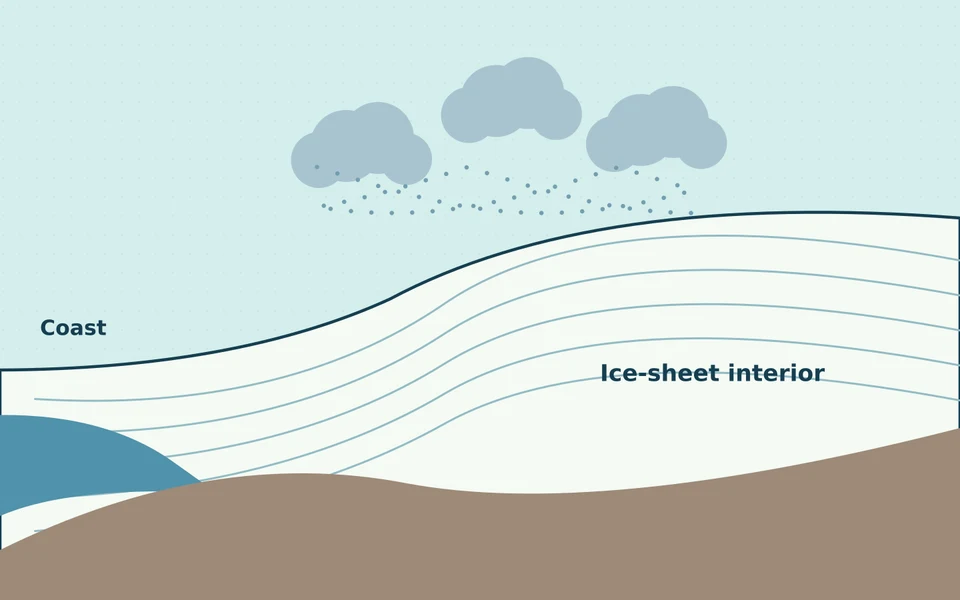
When a warming atmosphere carries more moisture over a very cold ice sheet, some of that moisture can fall as snow. A cloudier sky can also reduce the sunlight reaching the surface. Those changes have a surprisingly large effect in a study published on 30 October that followed simulated ice sheets over 100,000 years. In the East Antarctic interior, they partly offset ice loss that would otherwise occur in the model.
Researchers at the IBS Center for Climate Physics at Pusan National University and their collaborators used a model that lets the atmosphere, oceans and ice sheets change together. They ran idealised experiments at different concentrations of carbon dioxide. The point of such a long calculation is to explore how the interacting parts of the system can evolve under sustained conditions. It does not put a date on what will happen to any one glacier in this century.
What happens when two responses are switched off?
In one comparison, the researchers excluded the changes in precipitation and sunlight that warming produced. Under the strongest forcing, the simulated Antarctic ice sheet then lost around 70% of its volume. When the climate and ice responded to one another and those atmospheric changes were included, the loss was around 20%. These are results for two model configurations under extreme conditions. They are not percentages of ice already lost or measured in recent satellite records.
The physical reasons are easier to see by following the water and energy. Additional snow can add mass where temperatures still allow it to accumulate. Clouds that reduce incoming sunlight can leave less energy available for surface melting. How much these effects matter depends on the location. Ice exposed to warming ocean water below the surface is subject to another set of influences.
Two sides of a continent
The model produced major long-term losses in marine-based West Antarctica under sustained warming above about two degrees Celsius relative to preindustrial conditions. East Antarctica’s large land-based interior proved more resistant in the experiments. Parts of East Antarctica are already retreating, and a result about the interior does not give every coastal outlet the same outlook. The related simulation of Greenland also behaved differently.
The researchers identified a practical limitation. A global model running for so long cannot represent every process underneath an ice shelf or every narrow glacier in fine detail. A higher-resolution regional study can examine what happens at a particular outlet. This experiment tackles a different scale, asking how much the answer changes when snowfall, clouds and ice are allowed to influence one another. Its large difference between simulations shows why those interactions deserve a place in the next generation of models.