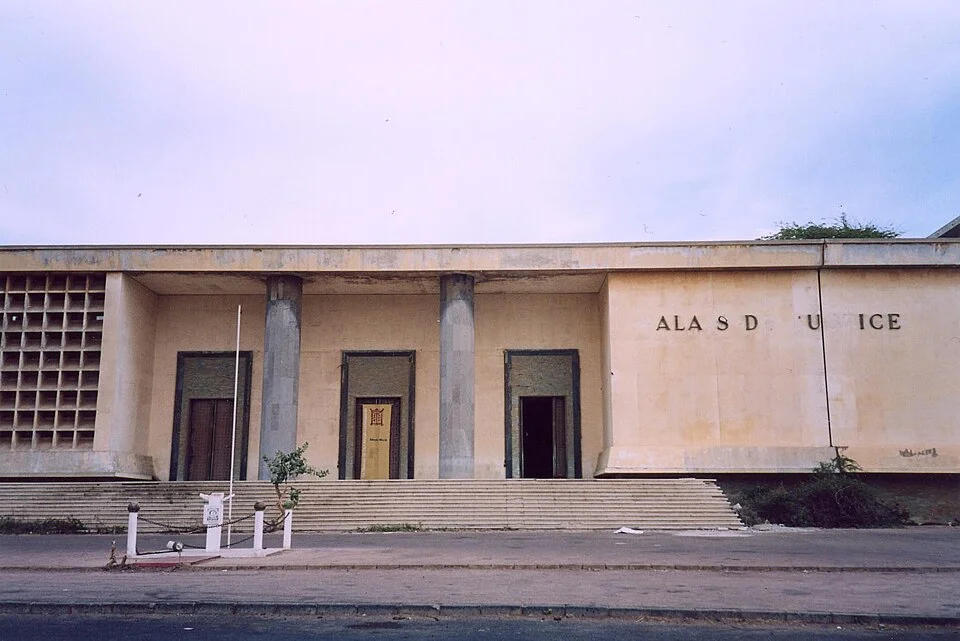
- The Dakar Biennale runs from 19 November to 19 December, with public visitors arriving at the former courthouse on Friday.
- Organisers list 54 artists for the main international exhibition and 22 for the design section.
- The accompanying OFF programme gives independent spaces throughout the city a role in what visitors discover.
Inside this story 2 perspectives
In Dakar’s former courthouse, a monster from Greek mythology has found work in the goldfields of eastern Cameroon. Cameroonian artist Jean-David Nkot uses the Hydra, the many-headed creature that grows new heads when one is cut off, to depict miners. People reaching a public exhibition in Senegal on Friday could encounter a question usually posed in the language of commodity prices: what does extracting gold ask of the people who do it?
Nkot’s work is part of the 16th Dakar Biennale of Contemporary African Art. The organisers’ calendar runs from 19 November to 19 December. The theme, written as “(Anti)fragilité”, asks what might emerge after something has been put under strain. Nkot’s miners give the idea a subject as precise as a body at work. Elsewhere it takes forms that a visitor would struggle to fit under the same label.
What a visitor can find beyond the official selection
The organisers list 54 artists in the international exhibition and 22 in its design section. The Democratic Republic of the Congo is the guest country of honour, with artist Steve Bandoma curating its pavilion. Senegal also has a national pavilion. Each offers a deliberately assembled view of the work being made in a country. Seeing the two on the same visit gives a viewer good reason to be suspicious of any single description of contemporary African art.
Some of the most interesting choices a visitor makes will come after leaving those rooms. The independent exhibitions known collectively as the OFF carry the festival into other spaces. Associated Press reported more than 450 pop-up shows across venues ranging from hotels to neighbourhood galleries. Even someone who lived in Dakar for the entire month would have to choose a route through that abundance.
A useful itinerary might follow a material or a question instead of a list of prominent names. Start with Nkot’s account of mining, then ask a gallerist where else an artist is working with land or the human body. A smaller venue gains something when the next address comes from a conversation across town. So does a visitor who sees work beyond the pieces already selected for the official exhibition.
The people looking for their next acquisition
Among Friday’s visitors were two curators from the Worcester Art Museum in Massachusetts. They told AP of their interest in contemporary African work and the West African communities in their own city. A conversation in Dakar could help shape what a family finds years later in a museum on another continent.
That is one kind of afterlife for an exhibition. Another belongs to the Dakar resident who can walk into a neighbourhood venue, argue with a friend about a work and return before it comes down. An acquisition may eventually make headlines. For the next month, it is the ability of both visitors to see the work that makes this city such a consequential place to show it.