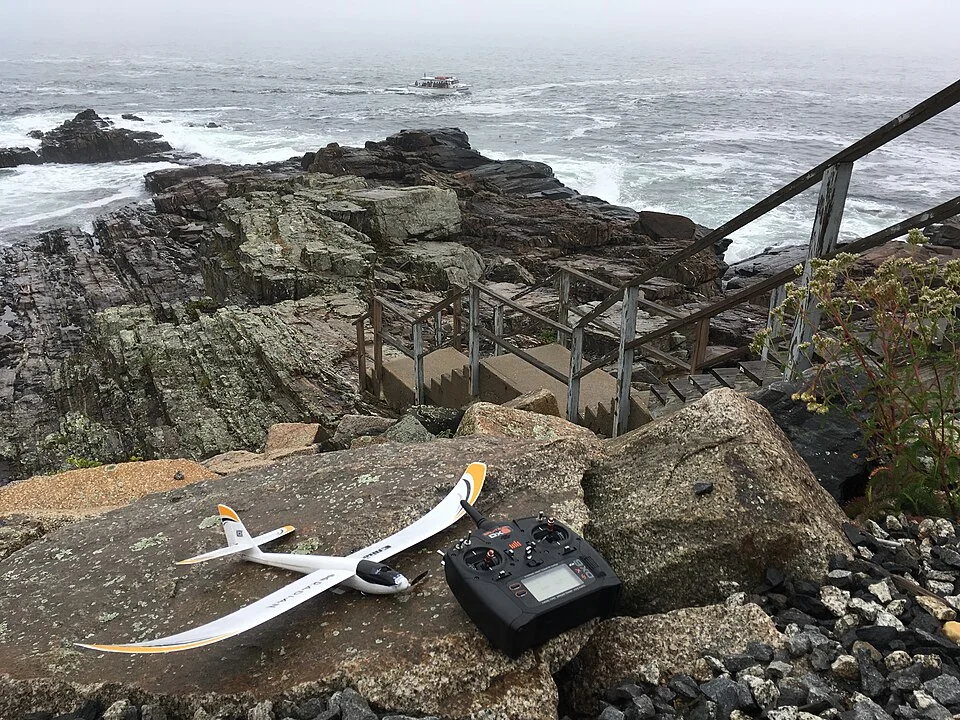
- Four structural supercapacitors stiffened a model glider’s wings and supplied its motor.
- The demonstration covered about 12 feet with power and eight feet without.
- The researchers recovered a carbon-fibre component and reused it twice in further devices.
Inside this story 2 perspectives
A powered glider travelled about twelve feet. Switched off, it covered about eight. On distance alone, the experiment from the University of California San Diego sounds modest. Look inside the wings and the point becomes clearer. Four thin devices helped stiffen the structure while supplying the electricity for the propeller. The researchers were testing whether material the aircraft already needed to carry could serve a second purpose.
The work appeared in ACS Energy Letters and was described by the university on 20 August. It concerns a structural supercapacitor, a device designed to bear a load as well as store and release electrical energy. For something that flies, both roles compete for a scarce resource. Every component contributes weight, whether it holds the wing straight or powers a motor.
One part, two jobs
In a conventional arrangement a separate energy-storage device is fitted into the structure. Designers have to allocate space and mass to both. Built into the wing, the experimental devices contributed stiffness where it was needed and supplied energy from that same location. The comparison between powered and unpowered flights demonstrated that they could run the propeller. Twelve feet is not a prediction of range for an aircraft carrying people or cargo.
There is another comparison to make before anyone can judge whether a combined component is worthwhile. How much electricity can a dedicated storage device hold at the same weight, and how much stiffness does an ordinary structural part supply? A design that performs both jobs could still lose its advantage if meeting one requirement meant adding substantial material elsewhere. The university’s demonstration gives researchers an object on which they can ask those questions.
The second life of the wing
Making functions inseparable during use often makes components difficult to separate at the end of their life. The San Diego team designed its layers so that parts could be recovered. The researchers took a carbon-fibre electrode out of one device and used it to build another, repeating the process twice. Across its initial use and those two rounds of reuse, the electrode completed more than 172,000 cycles of charging and discharging with similar electrical performance.
That count belongs to the electrode across successive devices. It is not the number of flights made by the model or proof that an entire wing can be recovered indefinitely. It does identify a promising question for the next stage. Can a part expensive enough to matter be removed in sufficiently good condition for another use?
For designers of small, lightweight devices, a useful figure may eventually be the combined mass saved over two or three product lives. The glider makes both halves of that calculation visible. First a wing carries the electricity, then an electrode gets another chance to carry it.