- ESA confirmed Samba’s reentry at 21:39:38 UTC on 31 August.
- Fresh orbital data narrowed the uncertainty from ten minutes to ten seconds before reentry.
- An aircraft carrying 30 instruments was assigned to observe the event from near the edge of the exclusion zone.
Inside this story 2 perspectives
When the European Space Agency described the final orbit of its Samba satellite on 24 August, its estimate for reentry included ten minutes of uncertainty on either side. By the afternoon of 31 August, new tracking data had brought that margin down to ten seconds. That night mission control confirmed that Samba had reentered over the South Pacific at 21:39:38 UTC, the time in the afternoon’s prediction.
The precision had a practical consequence beyond the control room. A team flying out from Tonga was assigned to observe the end of the spacecraft’s journey with 30 instruments. From an aircraft, a difference of minutes could shift the view from a carefully chosen stretch of sky to the wrong side of a window. The flight had to reach its observation position, face the right way and stay safely clear of the area set aside for reentry.
Why fly out over the ocean?
The remote location was chosen deliberately. In January, controllers manoeuvred Samba and its sibling Tango onto paths designed to bring them down over the South Pacific. Airborne instruments could watch an event planned far from populated areas. Their purpose was to collect observations of what happens when an actual satellite meets the atmosphere at speed, something that ground testing and computer models can represent only in part.
Ground-based tracking supported the last predictions. A telescope can establish where a small moving point appears against a field of stars. Combining such observations with orbital data helps pin down where the spacecraft is headed. Following the path of the whole satellite and studying the light produced as its components come apart are different jobs. Putting instruments in the air brought the second job closer to the event.
Four points once made a picture
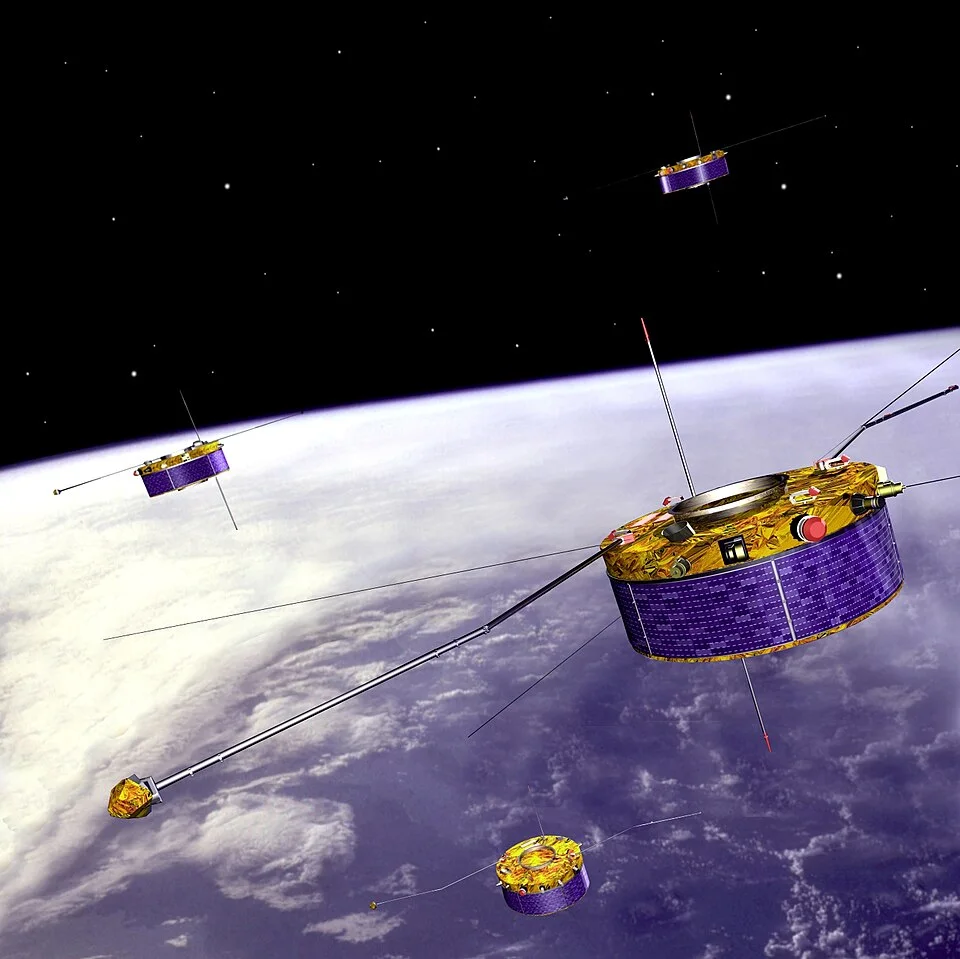
Samba’s original work had also depended on where instruments stood relative to each other. It flew as one of four similar spacecraft in the Cluster mission. Their positions formed a three-dimensional shape that allowed researchers to compare conditions at several locations in the plasma around Earth. A single spacecraft encountering an abrupt change can struggle to tell whether it has crossed a boundary or whether conditions have changed over time. Measurements from several positions help resolve the ambiguity.
The scientific mission ended in 2024, and Samba was the third of the four spacecraft to reenter. Tango’s return was scheduled for 1 September. The timetable presents engineers with a rare pair of opportunities. Spacecraft of similar design can be observed on successive nights, with the same airborne campaign and a planned destination over the ocean. On Monday night, the first of the two reached that destination on time. The interpretation of what its passage revealed belongs to the instruments and the work that follows.