- The Göttingen team outlined the finding on 7 October, after the paper appeared on 1 October.
- Tiny coesite inclusions provide evidence that the rock reached depths of at least 90 kilometres.
- The intermediate stage was hotter than expected. The authors identify more than one possible explanation.
Inside this story 2 perspectives
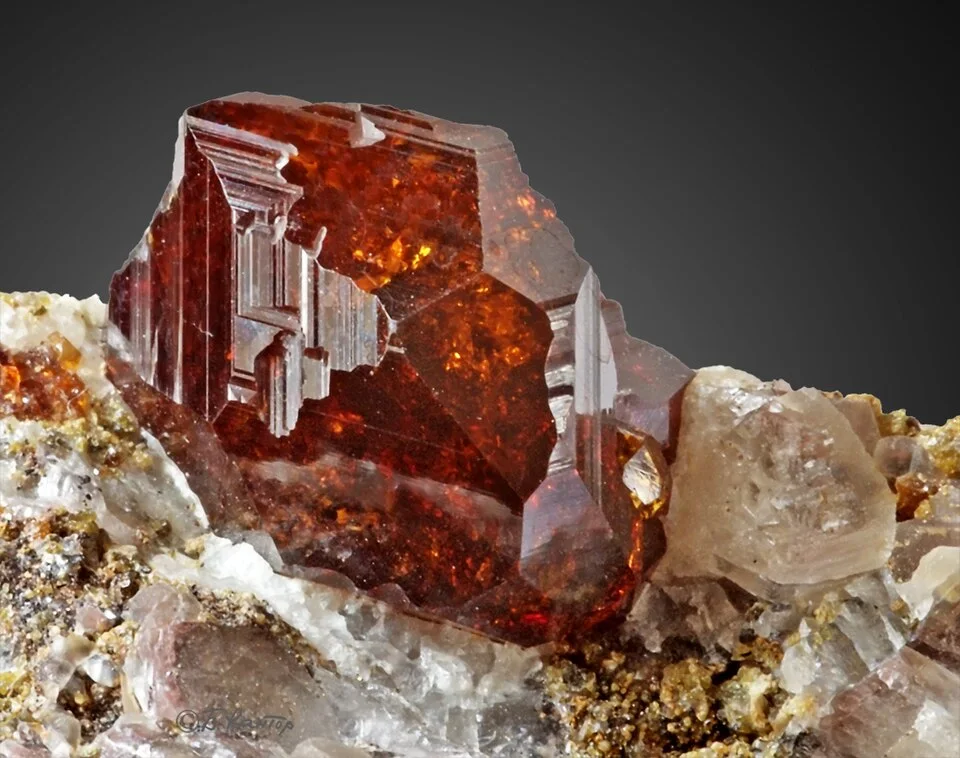
A red garnet crystal in a rock from eastern Papua New Guinea contains a mineral inclusion smaller than a thousandth of a millimetre. For the scientists who studied it, that speck provides evidence of a journey at least 90 kilometres below the Earth's surface. The mineral, coesite, forms under extremely high pressure. Trapped inside its host crystal, it preserves evidence of conditions that are long gone at the place where the rock can be examined today.
The surprising part of the journey was higher up. In a research announcement dated 7 October, a team led by the University of Göttingen described a rock that experienced roughly 800 degrees Celsius at its greatest recorded depth. At around half that depth, about 45 kilometres down, conditions had already reached approximately 700 degrees. That intermediate stage was much hotter than expected from the usual picture of one tectonic plate descending beneath another.
A record of a changing gradient
Geologists call the process subduction. As a plate descends it carries material into conditions of increasing pressure, where minerals can change or new ones can form. The resulting red-and-green rock in this study is an eclogite. The team examined the minerals enclosed inside garnet and used zircon inclusions to place the record at approximately 4.4 million years ago. The detailed findings appeared in Nature Geoscience on 1 October.
Calling one phase hot and another relatively cold can sound puzzling when the deeper temperature was actually higher. The terms refer to temperature in relation to depth. A rock that has already reached about 700 degrees at 45 kilometres and gains only about another 100 degrees on its way down to roughly twice that depth has experienced a change in the rate at which temperature rises. The intermediate and deeper records together make that change visible in a way that either endpoint alone could not.
Why one specimen matters to a model
Researchers have found rocks recording unexpectedly high temperatures before. What the Papua New Guinea specimen adds is a sequence. In the authors' interpretation the same material passed from unusually warm shallower conditions to a deeper regime with a lower temperature gradient. An explanation has to account for both parts of that path in the order in which they occurred.
One possibility is additional heating from shearing where the plates met. Another is that the subduction zone had not yet had enough time to develop a colder temperature structure. The two effects could also have acted together. The discovery gives geologists a way of asking which mechanisms can reproduce the mineral record. For now the most secure point is the one preserved at the smallest scale. A minute mineral enclosed in a garnet places an extraordinarily deep stage on the itinerary of an accessible piece of rock.