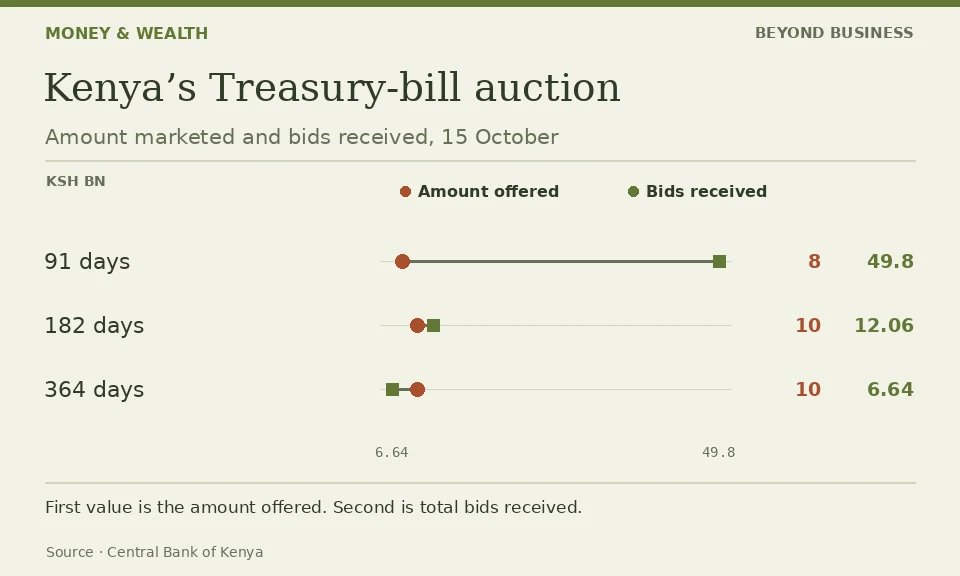
- The 19 November auction drew KSh 44.1 billion in bids against KSh 28 billion advertised.
- At the average accepted rate, the 91-day bill cost around KSh 97.87 per KSh 100 of face value before tax.
- The three published rates are annualised. They apply to different periods, and a future auction can clear at a different price.
Inside this story 2 perspectives
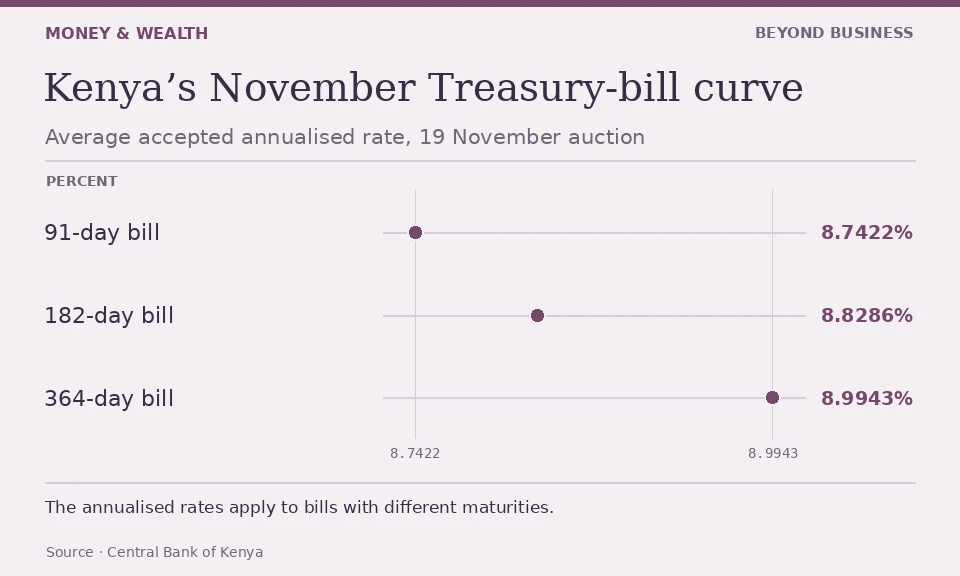
A saver looking at Kenya’s 91-day Treasury bill this week will see an interest rate of 8.7422%. Three rows further down the Central Bank of Kenya’s auction sheet sits a more immediately useful number: KSh 97.8669. That is the price per KSh 100 of face value at the average accepted rate. It tells the buyer how the government’s promise to repay a fixed amount translates into money paid up front.
Thursday’s auction attracted KSh 44.1 billion in bids across three maturities, against KSh 28 billion advertised. The central bank’s weekly bulletin on Friday put the subscription rate at 157.5%. Some KSh 22.7 billion of bids went into the shortest bill alone, against an advertised KSh 8 billion. The six-month bill, by contrast, drew less than the KSh 10 billion on offer. There was healthy overall demand, but investors were making different choices about time.
From the quoted rate to cash
Take KSh 100,000 of face value in the 91-day bill. At the published average price, its discounted cost works out to about KSh 97,867 before tax or charges. The two numbers differ by roughly KSh 2,133. That is the gross interest represented by the discount over the term. The official maturity date for this issue is 22 February 2027.
The 8.7422% figure expresses the rate on an annual basis. Applying it directly to KSh 100,000 as though the bill runs for a whole year would overstate what the buyer earns over 91 days. Actual cash paid and retained also depends on applicable tax and charges. Keeping face value, purchase price and maturity date together avoids much of the confusion.
The extra months change the comparison
The accepted average rate on the 182-day paper was 8.8286%. On the 364-day bill it was 8.9943%. All three edged down from the previous auction. The longest offered a somewhat higher annualised rate, but its scheduled repayment date is 22 November 2027. That is a different proposition for a business holding money for a February supplier payment.
A shorter bill also leaves a question open. If its proceeds are rolled into another bill at maturity, the second purchase happens at the rate available then. A calculation that assumes four successive purchases at this week’s terms builds a forecast into what looks like simple arithmetic. Meanwhile, a business expecting a foreign-currency invoice has a further comparison to make: its bill pays in shillings, while the amount needed to settle the invoice can change.
The auction result gives savers a precise historical price. The useful comparison starts by writing down the amount due, the currency it is due in and the date the money needs to be available. Only then do the three percentages describe genuinely comparable choices.