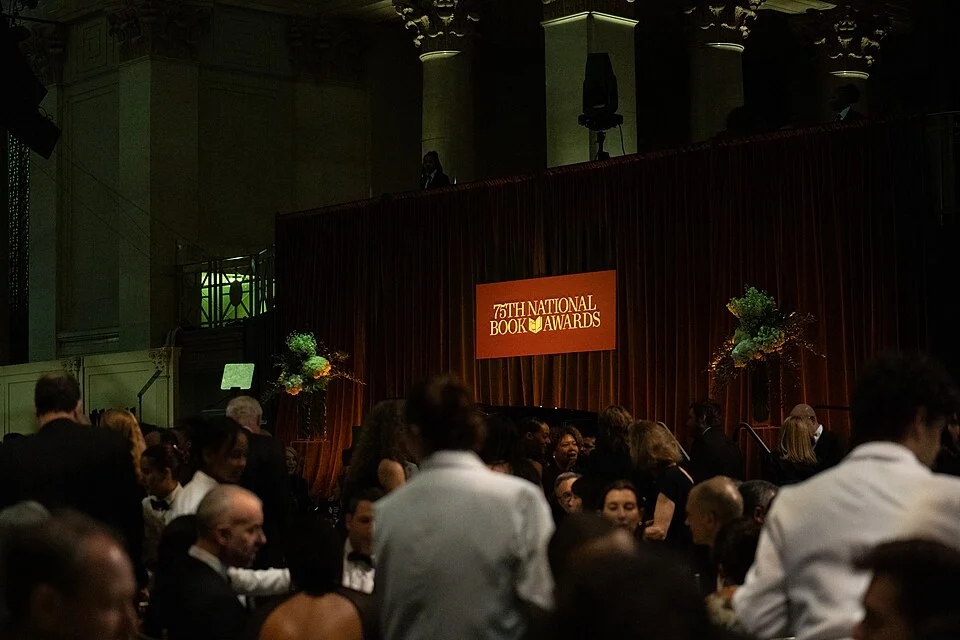
- ElGendy’s debut memoir won the nonfiction prize at the US National Book Awards on Wednesday evening in New York.
- He was seventeen when he and his father were detained in Cairo in 2013. He spent six years in prison.
- His editor read his acceptance speech after the United States denied him a visa to attend.
Inside this story 2 perspectives
Abdelrahman ElGendy once rehearsed an award acceptance speech under a duvet in an Egyptian prison. On Wednesday night in New York he had a real speech to give. His memoir Huna had won the US National Book Award for nonfiction. His editor, Helen Thomaides, had to stand up and read it for him. The United States had denied him a visa to attend.
It is a striking ending to an awards ceremony and an incomplete way to describe a writer. ElGendy’s book returns to a relationship that began long before a prize jury knew him. In 2013, when he was a seventeen-year-old student activist in Cairo, his father went with him to a demonstration because he feared for his son’s safety. They were both detained. ElGendy spent six years in prison.
The difficulty of a small word
The title comes from a protest song ElGendy heard in a holding cell. Huna is the Arabic word for “here”. In the song, people promise to remain here. In a cell, the teenager heard a puzzle in that declaration. How could he want to stay in a place from which he badly wanted to get free?
That small problem of language opens up a much larger one for a memoirist. A prison can fix a person’s whereabouts very precisely and still tell a reader almost nothing about who is there. ElGendy read, wrote and earned an engineering degree while incarcerated. The time he measures in Huna includes the changing relationship between a father and a son, as well as the years that passed on a calendar.
He later became a translator as well as an author. His English-language readers can look up the meaning of the title in seconds. Understanding what the word came to mean to one teenager in Egypt is a reason to read a book. The distinction matters wherever a work travels across national and linguistic borders. Knowing what happened to a writer is a beginning. It does not tell you how he decided to tell it.
A book and its author travel differently
Huna was published in September. By November it could be bought in the United States, debated by a jury there and honoured at a New York ceremony. Its author could do none of the ordinary things that make an awards evening personal, such as thanking an editor face to face as the news lands.
Thomaides could deliver his words. She could not supply the part of the evening in which a living author meets the people who read them. For book clubs deciding what to pick up after the awards, there is a way to give him back some of that room: start with the question the teenager asked about a song, and let him tell the rest.