- Curiosity landed on Mars on 6 August 2012 in universal time.
- The Canadian APXS instrument investigates the chemical composition of rocks and soils.
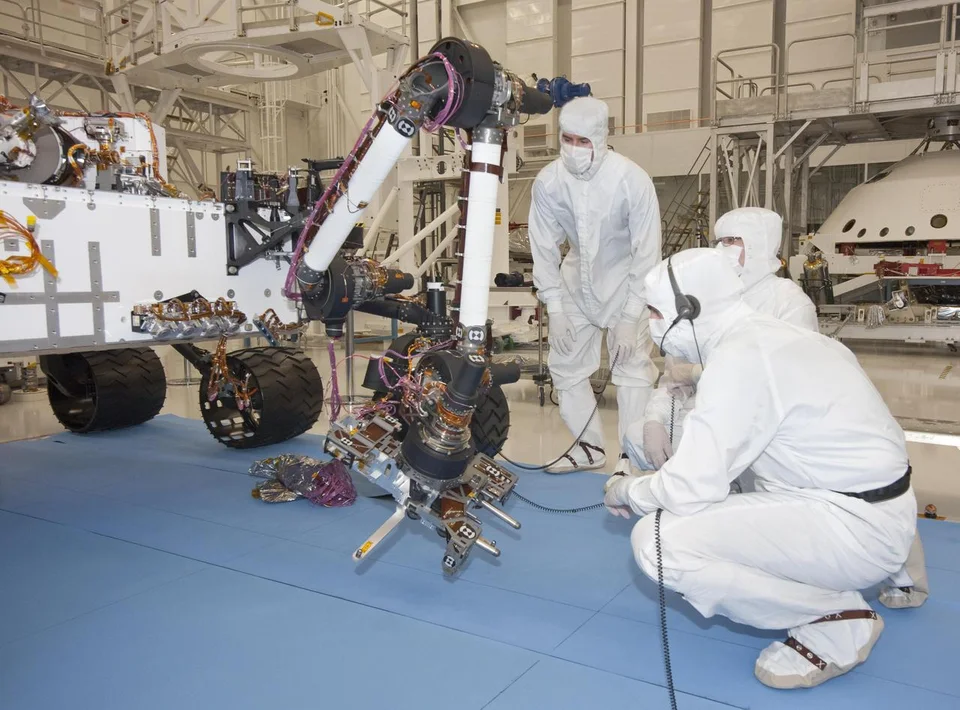
- Engineers help choose targets that the robotic arm can reach safely and that scientists can interpret.
Inside this story 2 perspectives
The engineering challenge on Mars does not end when the vehicle lands. Fourteen years after NASA’s Curiosity rover touched down on 6 August 2012, a scientist can still see an inviting piece of rock in a picture and have to ask an engineer whether the arm can actually get there.
Lucy Thompson, a University of New Brunswick researcher who helps plan measurements for Curiosity, described the exchange in a July mission update. The ground within reach had been dusty and uneven. The engineers nevertheless identified five targets that the rover could brush and examine during the planning period she described. The scientific achievement was partly a matter of parking, reaching and finding a patch of rock clean enough to say something useful.
A laboratory at the end of an arm
One instrument involved is the Alpha Particle X-ray Spectrometer, or APXS. Canada supplied it for the mission. Its sensor sits at the end of the robotic arm and is roughly the size of a Rubik’s cube. Placed close to a sample, it prompts the material to emit signals that identify the chemical elements present. A close-up camera can show the texture around the spot being measured.
The two views complement one another. A picture can suggest that a dark layer breaks a run of lighter beds, but colour alone cannot settle whether their chemical compositions differ. An elemental reading from an isolated point can tell scientists what was in reach of the sensor, while saying little about how far a particular layer extends. Together, the close-up, the chemistry and the wider view of the hillside allow a more careful comparison.
The Canadian Space Agency counted 1,761 samples analysed with APXS by 1 February 2026. It also counted 3,943 results sent to Earth. Those totals refer to different things. Neither is a count of newly discovered kinds of rock, and neither should be mistaken for a reading taken on the anniversary itself.
Looking for an environment
When Canada announced the landing in 2012, it described a mission planned for one Martian year, about 687 Earth days. One question was whether this part of Mars could once have offered conditions suitable for microbial life. A chemical measurement can contribute to that question, for instance by helping researchers recognise evidence of rocks altered by water. It cannot, on its own, establish that living organisms were present.
Fourteen Earth years make an impressive anniversary. The less obvious measure of that time is a sequence of comparable observations collected as the rover changes location. A layer higher up Mount Sharp means more when scientists can set its texture and chemistry beside a layer examined lower down. For that history to be readable, the engineers still have to get the instrument safely to the next stone.