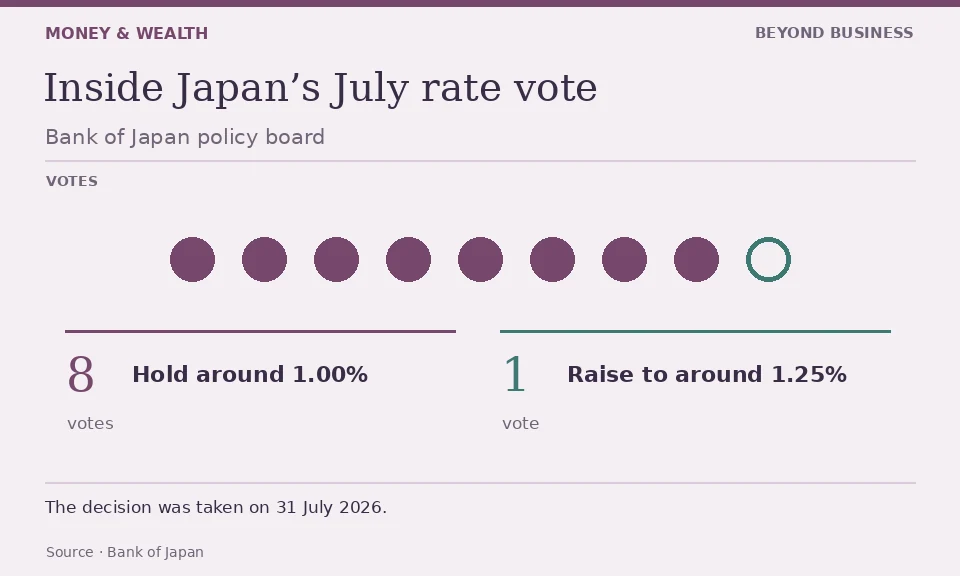
- The policy board voted 8–1 to keep the overnight call rate around 1.25%.
- It unanimously set an annual ETF sale pace of roughly ¥860 billion at book value, starting in January 2027.
- The central bank gave a separate market-value equivalent of about ¥2.46 trillion.
Inside this story 2 perspectives
Japan’s central bank kept its overnight interest rate around 1.25% on 30 October. It also decided to make a considerably larger change in what it plans to sell on the stock market. Starting in January 2027, the Bank of Japan intends to sell exchange-traded funds at a pace of about ¥860 billion a year measured at book value. The previous plan set the pace at roughly ¥330 billion. Keeping the first number steady did not keep both parts of policy still.
The distinction was visible in the votes. Eight members backed the interest-rate guideline and one dissented. The decision on the pace of ETF sales was unanimous. The central bank has held the funds as assets on its own balance sheet. Selling part of that stock gradually is a different operation from guiding the rate at which institutions lend overnight without collateral.
One sale plan, two yen amounts
The central bank also put an indicative market value of about ¥2.46 trillion on the new annual sales pace. That could be mistaken for a second, much larger sale programme. The statement explains that it converted the book-value amount using the market-to-book ratio of ETFs sold over a reference period. Book value reflects how the holding is carried in the accounts. The price at which it can be sold depends on the market.
The bank also expressed the new pace relative to activity on the exchange. It aims at a scale equivalent to roughly 0.1% of trading value, with the calculation drawing on the Tokyo Stock Exchange Prime Market. That comparison helps readers understand why market size entered the decision. The bank said it had been selling since January 2026, and that turnover in the stock market had expanded.
An interest rate answers another question
In its accompanying outlook, the bank said underlying inflation was broadly consistent with its 2% price-stability target. The continuing question was how firmly it would remain there. A policy rate of 1.25% and a 2% inflation objective are different quantities. The first is the operating guideline for the interval between meetings, while the second describes the price behaviour policy seeks over time.
For someone following the decision, the dates are as important as the percentages. The overnight rate guidance applies after this meeting. The higher ETF disposal pace is scheduled for the following January and is expressed as an annual rate, not an order to sell an entire year’s allocation in one session. The document gives one account of the cost of short-term money and another of how the central bank intends to reduce a stock of investments accumulated over time.