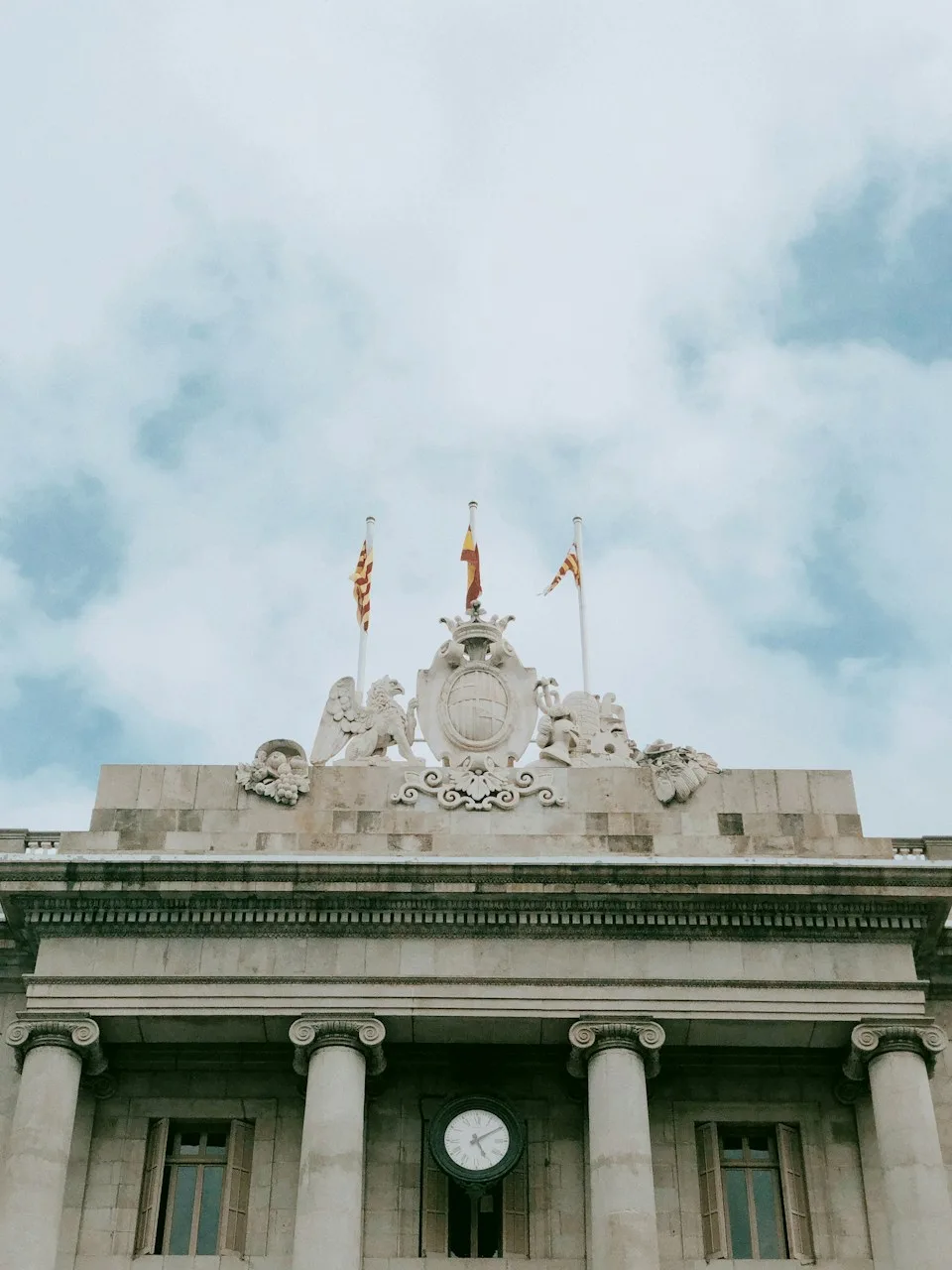
- The morning begins and ends in Plaça de Sant Jaume.
- The official retinue travels to the basilica for a service while part of the programme stays in the square.
- City giants, the Eagle and the human tower teams have different roles in the festivities.
Inside this story 2 perspectives
A visitor looking at the Mercè programme on 24 September could circle Plaça de Sant Jaume three times without ever leaving the square. Barcelona’s celebration brings together moving processions, dances performed on the spot and human towers. The same location appears repeatedly because it works as a departure point, a performance space and a place of return. A good morning here begins with choosing which of those moments to see.
The local broadcaster betevé listed the first call for 9.30am, when groups of gralla players were due in the square. Their reed instruments help announce the occasion. Around 10am the official procession was scheduled to set off for Plaça de la Mercè, where the religious service takes place. People following the procession see the ceremonial figures moving through the old city. Anyone who stays behind sees a different sequence unfold in the space they have just vacated.
Leaving with the procession or staying for the giants
A display of giants’ dances was on the midmorning programme at Sant Jaume. The figures move through the work of the carriers inside, so the interest lies partly in the turns, the rhythm and the space that each pair needs to complete a dance. Seeing a figure go past on a street gives an impression of its scale and costume. Seeing it dance beside another in a square shows what its carrier can make it do.
Neighbourhood associations are participants in their own right. The Gegants de Gràcia calendar, for example, identifies the engagements of its own group during the festival. A time listed for an individual troupe can refer to its part in a larger programme. For someone planning a visit around one square, the public running order provides a better starting point than assuming every group’s listing describes the whole morning.
The second arrival
Around noon the bells mark the return leg from the basilica. Betevé’s timetable put the arrival at Sant Jaume around 12.20pm, followed at 12.45pm by the dances of the Eagle and the City Giants with Barcelona’s Municipal Band. These are particular civic figures, with particular dances. A family primarily interested in seeing them together could choose the return and spend the earlier part of the morning elsewhere.
At 1pm the programme turns to castells, the human towers built by teams of people. For a visitor with room for only one more event, it is worth knowing that the word signals an entirely different performance. After a morning spent watching carriers make giants dance above the crowd, the people climbing above the square are themselves the spectacle.